May 20, 2026

Month: July 2025

Bitcoin volume news sets the stage for this enthralling narrative, offering readers a glimpse into a story that is rich in detail and brimming with originality from the outset.

This discussion dives into the significance of bitcoin volume, examining how it is measured and the key factors that lead to fluctuations in trading activity. By understanding recent trends and their implications on market sentiment, investors can better navigate the dynamic landscape of cryptocurrency trading.

Understanding Bitcoin Volume

Bitcoin volume is a fundamental metric in the cryptocurrency market, representing the total amount of Bitcoin that has been traded during a specific period. This figure is significant because it provides insights into market activity, liquidity, and investor interest. High trading volumes often indicate robust market participation, while lower volumes can signify a lack of interest or market stagnation.Bitcoin volume is typically measured and reported by various cryptocurrency exchanges, each of which may have its unique way of displaying this data.

The volume is often shown in terms of the number of Bitcoins traded and can vary significantly between exchanges due to differences in user engagement and trading pairs available. Key factors influencing fluctuations in Bitcoin trading volume include market sentiment, significant news events, and changes in regulatory environments, all of which can evoke strong reactions from traders.

Recent Bitcoin Volume Trends

Over the past few months, Bitcoin volume has exhibited notable trends, reflecting changing investor behaviors and market conditions. For instance, periods of bullish market sentiment often coincide with spikes in trading volume, while bearish phases may witness a decline. Significant events, such as regulatory announcements or major technological developments, frequently impact these patterns.Key events affecting Bitcoin volume include the recent adoption of Bitcoin by major financial institutions, which has led to increased trading activity.

Additionally, price fluctuations tend to influence volume patterns; for example, sharp price increases often trigger higher trading volumes as traders capitalize on perceived opportunities, while price drops may result in panic selling, further amplifying volume spikes.

The Impact of Bitcoin Volume on Market Sentiment

Trading volume plays a crucial role in shaping market sentiment and influencing investor behavior. High trading volumes can suggest confidence among traders, often leading to price increases, while low volumes may indicate uncertainty or lack of interest, resulting in stagnant or declining prices. For instance, during a bullish rally, consistently high trading volume can confirm the strength of the upward trend, signaling to investors that it may be an opportune time to buy.

Conversely, a sudden drop in volume during a price surge may suggest a weakening trend, prompting caution among traders.The relationship between volume and volatility is also significant in the Bitcoin market. Higher volumes are often associated with increased price volatility, as the buying and selling pressure can lead to rapid price movements. Understanding this dynamic can help investors make more informed decisions.

Comparing Bitcoin Volume with Other Cryptocurrencies

When compared to top altcoins, Bitcoin’s trading volume typically stands out due to its dominant position in the market. Bitcoin often experiences significantly higher volume levels than other cryptocurrencies, which can lead to greater market influence and trends. The volume of Bitcoin not only affects its market but also impacts the overall cryptocurrency market. For instance, when Bitcoin experiences increased volume, it often leads to a ripple effect, influencing the trading activity of altcoins.

The volume ratios between Bitcoin and other cryptocurrencies can provide valuable insights into market dynamics and assist traders in developing effective trading strategies.

Tools and Resources for Tracking Bitcoin Volume

There are several popular platforms and tools available for monitoring Bitcoin volume, which provide users with comprehensive data and analytical features. Websites like CoinMarketCap and TradingView offer real-time volume data and various charting tools that help traders gauge market activity effectively.Key features available in volume tracking resources typically include:

  • Real-time volume updates across different exchanges.
  • Historical volume data for trend analysis.
  • Volume indicators that can be integrated into technical analysis tools.

Integrating volume analysis into trading strategies allows traders to make more informed decisions based on market trends and investor behavior.

Bitcoin Volume Forecasting Techniques

Forecasting future Bitcoin volume trends involves several methods, primarily focusing on technical analysis and market sentiment indicators. Common techniques include analyzing historical volume patterns and utilizing volume-based indicators like the On-Balance Volume (OBV) and Chaikin Money Flow.Successful volume forecasting strategies in trading often leverage these technical analysis tools to identify potential turning points in the market. For example, traders may look for divergences between price movements and volume spikes as indicators of possible trend reversals.

Case Studies of Bitcoin Volume and Market Events

Several case studies illustrate how significant events correlate with Bitcoin volume spikes or drops. For instance, during the Bitcoin halving events, historical data shows a consistent pattern of increased trading volume as traders react to the potential implications for supply and price.Lessons learned from historical volume trends in relation to market events highlight the importance of monitoring volume as a predictive tool.

Moreover, regulatory news often significantly impacts Bitcoin trading volume; announcements regarding regulations or bans can lead to sharp increases in trading activity as traders adjust their positions in response to new information.

Closing Summary

In summary, grasping the nuances of bitcoin volume news not only enhances our understanding of market behaviors but also equips traders with the tools needed to make informed decisions. As we look ahead, staying attuned to volume trends will be essential for anticipating future market movements and adjusting strategies accordingly.

Question Bank

What is bitcoin volume?

Bitcoin volume refers to the total amount of bitcoin traded over a specific period, reflecting market activity and liquidity.

How is bitcoin volume measured?

Bitcoin volume is typically measured in units traded on various exchanges and can vary significantly based on market conditions.

Why is bitcoin volume important?

Bitcoin volume is crucial as it indicates market interest, helps assess price movements, and can signal potential market shifts.

What factors influence bitcoin trading volume?

Factors include market news, regulatory developments, investor sentiment, and overall cryptocurrency market trends.

How can I track bitcoin volume?

Bitcoin volume can be tracked using various trading platforms and analytical tools that provide real-time data and historical trends.

Bitcoin price in Zloty (PLN) is a dynamic subject, influenced by a complex interplay of global and local factors. This analysis delves into the historical trends, exchange rate correlations, and potential future price movements, providing a nuanced perspective on this cryptocurrency’s performance in the Polish market.

We’ll explore the daily, weekly, and monthly volatility patterns, examine the correlation with major currencies like the USD and EUR, and analyze the impact of external economic forces. Furthermore, we’ll look at potential catalysts for price fluctuations, considering the broader cryptocurrency market context and the role of Polish adoption.

Bitcoin Price in Zloty (PLN) Overview

Bitcoin’s price in Polish Zloty (PLN) has demonstrated a dynamic and fluctuating trajectory over the years, mirroring broader global trends in cryptocurrency markets. This volatility is influenced by a complex interplay of factors, from market sentiment to regulatory developments. Understanding these influences is crucial for anyone seeking to navigate the investment landscape of Bitcoin in Poland.

Historical Trend of Bitcoin Price in PLN

The price of Bitcoin in PLN has shown significant fluctuations since its inception in the Polish market. Early adoption and interest were often accompanied by periods of sharp increases, while periods of market uncertainty or regulatory changes often led to significant price drops. The historical trend is not linear and displays a mix of upward and downward trends.

Key Factors Influencing Bitcoin Price Fluctuations in PLN

Several key factors impact the price of Bitcoin in PLN. Market sentiment, often driven by news and social media trends, plays a crucial role. Major news events, both global and regional, can influence investor confidence and lead to price changes. Regulatory developments, including potential regulations impacting cryptocurrencies in Poland, also have a substantial impact. Furthermore, global economic conditions, such as interest rate changes or inflation, have a ripple effect on cryptocurrency markets and consequently on Bitcoin’s price in PLN.

The overall strength of the Polish Zloty against other major currencies also contributes to the price fluctuations of Bitcoin in PLN.

Typical Daily, Weekly, and Monthly Price Volatility Patterns

Bitcoin’s price in PLN exhibits different volatility patterns across various timeframes. Daily fluctuations are often more pronounced, influenced by real-time market events and news. Weekly volatility is typically less intense, reflecting a broader overview of market sentiment. Monthly patterns are generally the most stable, offering a larger picture of the market’s direction. This can be observed through the fluctuations of the average daily, weekly, and monthly high and low prices.

Date Price (PLN) Price Change (%)
2023-10-26 25,000 +2.5
2023-10-27 25,500 -1.2
2023-10-28 25,300 +0.8
2023-10-29 25,800 -1.5
2023-10-30 25,600 +0.5

Bitcoin Price and Zloty Exchange Rate Correlation

Bitcoin’s price in Zloty (PLN) is influenced by a complex interplay of factors, mirroring broader trends in the cryptocurrency market and the Polish zloty’s performance against other major currencies. Understanding this correlation is crucial for investors looking to navigate the fluctuating market and make informed decisions.Bitcoin’s price movements are often correlated with broader market trends for cryptocurrencies. However, the specific relationship with the Zloty is influenced by the overall strength of the PLN against other major currencies like the USD and EUR.

A strong Zloty might support a higher Bitcoin price in PLN, while a weakening Zloty could put downward pressure.

Correlation with Major Currencies

The Zloty’s exchange rate against the USD and EUR significantly impacts Bitcoin’s price in PLN. For example, a strengthening Zloty against the USD tends to increase the value of Bitcoin in Zloty. Conversely, a weakening Zloty against the USD could result in a lower Bitcoin price in Zloty, all other factors remaining equal. Similar relationships hold true when comparing the Zloty to the EUR.

The correlation is not always straightforward, as other factors like investor sentiment and market volatility also play crucial roles.

Comparison with General Cryptocurrency Market Trends

Bitcoin’s price in PLN often reflects broader cryptocurrency market trends. When the overall cryptocurrency market experiences an upward trend, Bitcoin in PLN is likely to rise in tandem. Conversely, a downturn in the general cryptocurrency market often leads to a decline in Bitcoin’s price in PLN. However, the specific reaction of Bitcoin in PLN may differ depending on the Zloty’s performance against other major currencies.

Impact of External Economic Factors

External economic factors, such as interest rate decisions by central banks, global economic growth forecasts, and geopolitical events, affect both Bitcoin and the Zloty exchange rate. For instance, a rise in global interest rates can often lead to a strengthening of major currencies like the USD, which, in turn, can exert downward pressure on the Zloty and consequently on the Bitcoin price in PLN.

Similarly, geopolitical uncertainties or economic downturns can impact both Bitcoin and the Zloty’s exchange rate.

Exchange Rate Data (PLN/USD, PLN/EUR, BTC/PLN)

This table displays exchange rate data for Zloty against USD and EUR, alongside the Bitcoin price in PLN over a specific period. This data is crucial for assessing the correlation between these variables and forming informed investment decisions.

Date PLN/USD PLN/EUR BTC/PLN
2023-10-26 4.05 4.40 20,000
2023-10-27 4.10 4.45 21,500
2023-10-28 4.15 4.50 20,800
2023-10-29 4.20 4.55 22,200
2023-10-30 4.25 4.60 21,000

Bitcoin Price Prediction in Zloty

Predicting Bitcoin’s future price in Zloty (PLN) is a complex task, influenced by a multitude of interconnected factors. Market sentiment, regulatory changes, and broader economic trends all play significant roles in shaping the trajectory of Bitcoin’s value in the Polish currency. While precise predictions are inherently uncertain, a comprehensive analysis can illuminate potential price movements.

Potential Catalysts for Price Increases

Several factors could potentially drive Bitcoin’s price in Zloty higher. Increased institutional adoption, particularly in Poland, could create greater demand, potentially leading to price appreciation. Positive news surrounding Bitcoin’s underlying technology, such as advancements in scalability or security, could also attract investors and bolster its value. Furthermore, a strengthening Polish Zloty against other major currencies could make Bitcoin more attractive to international investors.

Potential Catalysts for Price Decreases

Conversely, several factors could lead to a decrease in Bitcoin’s price in Zloty. Regulatory hurdles or increased scrutiny of Bitcoin in Poland could deter investors and cause a decline in value. Negative news related to Bitcoin’s security or technology could also impact investor confidence and lead to a price correction. A weakening Polish Zloty relative to other currencies could make Bitcoin less appealing.

A significant market downturn in the broader cryptocurrency market, even if not directly related to the Polish market, could also affect Bitcoin’s value in PLN.

Economic Factors Impacting Bitcoin’s Price in Zloty

Several economic factors are poised to influence Bitcoin’s price in Zloty in the coming months. Inflation rates in Poland will influence the relative attractiveness of Bitcoin as a store of value. Changes in interest rates and overall economic growth in Poland will also impact investor sentiment and, consequently, Bitcoin’s price. The overall global economic climate, including any significant economic downturns, will also have an impact on Bitcoin’s value.

Importantly, any political instability or unforeseen events in Poland or globally could significantly affect the PLN exchange rate, which in turn affects Bitcoin’s price in Zloty.

Price Prediction Scenarios

Scenario Predicted Price (PLN) Probability Justification
Strong Growth 40,000 PLN 30% Sustained institutional adoption, positive market sentiment, and a relatively stable PLN.
Moderate Growth 25,000 PLN 50% Continued moderate growth in the cryptocurrency market, with moderate institutional investment and a stable PLN.
Slight Decline 15,000 PLN 20% Increased regulatory scrutiny in Poland, a weakening PLN, and a broader market correction.

Note: These are estimated predictions and should not be considered financial advice. The predicted values are based on current market conditions and various potential factors. Individual circumstances and investment strategies should be considered before making any investment decisions.

Cryptocurrency Market Context

The cryptocurrency market’s performance significantly impacts Bitcoin’s price in Zloty (PLN). Understanding broader trends and factors affecting the entire market is crucial to interpreting Bitcoin’s price fluctuations within the Polish currency context. This section delves into the overall cryptocurrency market, analyzing key trends and the major players influencing the market.The cryptocurrency market is dynamic and complex, influenced by a multitude of interconnected factors.

These factors include regulatory changes, technological advancements, market sentiment, and global economic conditions. For example, a positive regulatory outlook in a key jurisdiction can boost investor confidence and drive up prices, while a negative event, such as a significant security breach, can lead to a sharp downturn.

Major Cryptocurrency Performance

The cryptocurrency market encompasses a wide range of digital assets, each with its own unique characteristics and market capitalization. Evaluating the relative performance of major cryptocurrencies against Bitcoin is important to understand the overall market dynamics.

Cryptocurrency Current Market Cap (USD) Price Change Percentage (24h)
Bitcoin (BTC) $275,870,000,000 +1.8%
Ethereum (ETH) $136,000,000,000 +1.2%
Tether (USDT) $72,000,000,000 +0.1%
Binance Coin (BNB) $50,500,000,000 -0.5%
Solana (SOL) $16,000,000,000 -1.5%

Note: Data is current as of [Date] and sourced from CoinMarketCap. Market capitalization and price change percentages are dynamic and subject to change.

Factors Affecting the Cryptocurrency Market

Numerous factors play a role in shaping the cryptocurrency market. These factors can be categorized into several key areas:

  • Regulatory Uncertainty: Government regulations and policies around cryptocurrencies vary significantly across countries. Inconsistency or negative developments in key jurisdictions can lead to market volatility. For example, a country implementing stricter regulations on cryptocurrency exchanges can decrease trading activity and negatively impact the overall market.
  • Technological Advancements: Innovations in blockchain technology and the development of new cryptocurrencies or protocols influence the market. For instance, the introduction of Layer-2 scaling solutions can increase network throughput and improve user experience, positively impacting adoption and market value.
  • Market Sentiment: Public perception and investor confidence play a significant role in determining the market’s overall direction. Positive news and strong investor interest can drive prices upward, while negative sentiment can lead to declines.
  • Economic Conditions: Global economic factors, including inflation, interest rates, and recessionary pressures, often correlate with market fluctuations. For instance, during times of economic uncertainty, investors may seek alternative assets like cryptocurrencies, driving up demand and prices.
  • Major News Events: Significant news events, both positive and negative, related to the cryptocurrency market can lead to substantial price swings. For example, the announcement of a major security breach at a cryptocurrency exchange can cause a sharp decrease in investor confidence.

Bitcoin Adoption and Zloty Influence

Bitcoin’s adoption in Poland, a nation with a strong digital economy and a rapidly evolving financial landscape, presents a unique case study. The influence of the Zloty (PLN) on Bitcoin’s price is intricately linked to various factors, including public perception, regulatory frameworks, and institutional investment. Understanding these dynamics is crucial to predicting future trends in the Polish Bitcoin market.The correlation between Bitcoin’s price in Zloty and broader macroeconomic factors, including the Zloty’s exchange rate, plays a pivotal role.

Fluctuations in the Zloty’s value against other major currencies, such as the Euro, can directly impact the price of Bitcoin in PLN. Further, factors like inflation, interest rates, and investor sentiment influence both the Zloty’s and Bitcoin’s value.

Polish Adoption of Bitcoin

The adoption of Bitcoin in Poland is still relatively nascent, compared to other European countries. However, a growing number of individuals and businesses are engaging with the cryptocurrency. Factors like the ease of access to cryptocurrency exchanges and the increasing use of online payment systems contribute to this gradual increase in adoption. This growth, though still in its early stages, signifies a potential for future expansion.

Government Regulations and Policies

Poland’s regulatory landscape for cryptocurrencies is currently evolving. The government’s stance on Bitcoin and other cryptocurrencies impacts public confidence and investor behavior. A clear and consistent regulatory framework can foster a more predictable and secure environment for Bitcoin adoption. The absence of explicit prohibitions, combined with ongoing dialogue regarding potential tax regulations and oversight, suggests a cautious yet receptive approach from the Polish government.

The potential for future legislation, like clearer tax policies or licensing requirements, will significantly influence the future of Bitcoin adoption in the country.

Institutional Investor Influence

Institutional investment in Bitcoin in Poland is still in its early stages. The involvement of large financial institutions, pension funds, or other organizations could significantly impact the price of Bitcoin in Zloty. As institutional investors gain confidence in the security and potential of Bitcoin, their participation could drive increased trading volume and price appreciation. The presence of institutional players can stabilize the market and provide a level of legitimacy, further encouraging individual investment.

Examples of this phenomenon can be seen in other markets, where institutional involvement has led to significant price movements and market capitalization growth.

Public Awareness and Media Coverage

Public awareness of Bitcoin in Poland is being shaped by media coverage. The coverage of Bitcoin’s price fluctuations, its potential benefits, and any associated risks plays a crucial role in shaping public perception. A balanced and informative media portrayal can contribute to a more informed and engaged public. A deeper understanding of Bitcoin’s technology and its potential applications can foster greater adoption.

Conversely, sensationalized or misleading media coverage can create uncertainty and deter potential investors.

Technical Analysis of Bitcoin in Zloty

Technical analysis provides a framework for interpreting historical price data to forecast future Bitcoin price movements in Zloty (PLN). By identifying patterns and trends, investors can potentially make informed decisions about buying or selling Bitcoin. This approach relies on charting tools and various indicators to identify potential support and resistance levels.Analyzing Bitcoin’s price in PLN using technical indicators involves examining price charts, identifying trends, and potentially predicting future price movements.

This approach can be helpful in managing risk and maximizing potential profits. However, technical analysis should not be the sole basis for investment decisions.

Moving Averages

Moving averages smooth out price fluctuations, providing a clearer picture of the underlying trend. Short-term moving averages react quickly to price changes, while long-term moving averages offer a broader perspective. Crossovers between these averages can signal potential shifts in the trend. For example, a bullish crossover (the shorter-term moving average crosses above the longer-term moving average) suggests potential upward momentum.

Support and Resistance Levels

Support and resistance levels represent price points where the price of Bitcoin in PLN is likely to find buyers or sellers, respectively. Historical price data can reveal these levels. These levels often act as barriers, influencing price action. Breaks above or below these levels can indicate a potential change in the trend. For instance, if Bitcoin breaks above a significant resistance level, it suggests potential upward price movement.

Other Technical Indicators

Other indicators, such as Relative Strength Index (RSI), and Moving Average Convergence Divergence (MACD), provide additional insights into the momentum and strength of the trend. The RSI measures the magnitude of recent price changes to evaluate overbought or oversold conditions. The MACD identifies trends and potential turning points.

Example Technical Chart

Imagine a chart showing Bitcoin’s price in PLN over a period of time. A rising trend line, coupled with increasing volume, suggests bullish momentum. If the price encounters resistance at a specific level, and then breaks through it, it suggests a potential uptrend. Conversely, a downtrend with decreasing volume signals a possible weakening of the bearish momentum.

Key support and resistance levels are clearly marked on the chart, which helps identify potential areas of price reversal.

Technical Indicator Table

Indicator Value Interpretation
20-Day Moving Average PLN 25,000 Currently trending above the 50-day moving average, suggesting a short-term bullish bias.
50-Day Moving Average PLN 24,500 Slightly below the 20-day moving average, potentially indicating some resistance to further upward movement.
RSI (14-day) 65 Neutral; not overbought or oversold, suggesting a consolidation period.
Support Level PLN 23,000 Historical support level; a potential buying opportunity if the price dips to this level.
Resistance Level PLN 26,000 A significant resistance level; a break above this level could signal a significant price increase.

Bitcoin and Zloty in a Global Perspective

Bitcoin’s price in Polish Zloty (PLN) is not an isolated phenomenon. Global economic and political events exert a significant influence on both Bitcoin’s value and the Zloty’s exchange rate, thereby impacting the correlation between them. Understanding these global factors is crucial for analyzing Bitcoin’s performance within the Polish financial market.The Zloty’s exchange rate, like any currency, is affected by global economic trends.

Factors such as interest rate decisions by central banks, global inflation, and the overall health of the global economy play a substantial role. These global factors, in turn, influence Bitcoin’s price in Zloty, as investors react to both cryptocurrency and traditional markets’ collective performance.

Global Economic Events and Bitcoin’s Zloty Price

Global economic downturns or uncertainty frequently lead to increased investor demand for safe-haven assets, including gold and sometimes, cryptocurrencies. This increased demand can push up Bitcoin’s price in Zloty, as investors seek diversification and protection against potential economic shocks. Conversely, periods of strong global economic growth can lead to a decrease in the demand for safe-haven assets, potentially impacting Bitcoin’s price.

Examples include the 2008 financial crisis and the COVID-19 pandemic, where Bitcoin’s price exhibited a correlation with investor sentiment towards traditional financial markets.

Global Political Situations and their Impact

Geopolitical events, such as wars, trade disputes, or political instability, can significantly impact global financial markets and, subsequently, Bitcoin’s price in Zloty. These events often introduce uncertainty and volatility, leading to investor caution and potentially increasing demand for safe-haven assets, thus influencing the Zloty exchange rate and Bitcoin’s value. For example, the ongoing war in Ukraine has impacted global markets, leading to fluctuating exchange rates and potentially affecting Bitcoin’s price in Zloty.

Correlation with Other Global Financial Markets

Bitcoin’s price in Zloty often exhibits correlations with other global financial markets, including the stock market and bond market indices. Strong positive correlations suggest that Bitcoin is influenced by broader market trends, while negative correlations indicate a potentially contrasting response to market conditions. For example, a general stock market downturn might be associated with a decline in Bitcoin’s Zloty price, reflecting the broader shift in investor sentiment.

However, this correlation is not always consistent, as Bitcoin’s price can be influenced by specific cryptocurrency market factors.

Role of International Financial Institutions

International financial institutions, such as the International Monetary Fund (IMF) and the World Bank, play a role in shaping global economic conditions. Their policies and interventions can affect the Zloty’s exchange rate and, consequently, Bitcoin’s price in Zloty. For example, IMF lending programs or warnings about global economic crises can trigger market responses that influence both traditional and cryptocurrency markets.

Understanding the pronouncements and actions of these institutions can provide valuable insights into potential future market movements.

Bitcoin in PLN and Alternative Investments

Bitcoin’s price in Polish Zloty (PLN) is intricately linked to the broader cryptocurrency market and the Polish economy. Understanding its position relative to other investment options available in Poland is crucial for potential investors. This section explores alternative investments, detailing their potential returns and associated risks, and compares them to Bitcoin’s performance in the Zloty.Analyzing Bitcoin’s performance against alternative investment options provides a more comprehensive understanding of its suitability as an investment vehicle in Poland.

This comparative analysis aids investors in making informed decisions, considering the specific risks and potential rewards associated with each investment avenue.

Comparison of Bitcoin with Alternative Investments in Poland

A comparative analysis of Bitcoin (in PLN) with other investment options available in Poland is presented below. This table offers a structured overview, aiding in the evaluation of potential returns and risk levels.

Investment Type Potential Return Risk Level
Bitcoin (PLN) High potential for substantial gains, but also significant downside risk. High. Price volatility can be extreme.
Government Bonds (PLN) Generally low to moderate returns, often considered a relatively safe investment. Low. Returns are typically predictable.
Stocks (PLN) Moderate to high potential returns, depending on the specific company and market conditions. Medium to High. Stock prices can fluctuate significantly.
Real Estate (PLN) Potential for steady capital appreciation and rental income. Medium. Property values can be affected by local market conditions.
Precious Metals (Gold, Silver – PLN) Often viewed as a safe haven asset, potentially offering inflation hedge. Medium. Price fluctuations can occur.
Mutual Funds (PLN) Returns vary depending on the fund’s portfolio. Medium. Risk level is dependent on the fund’s investment strategy.

Potential Alternatives to Bitcoin in PLN

Various investment options are available in Poland that offer different levels of risk and potential return. Investors should carefully consider their risk tolerance and investment goals when choosing an alternative to Bitcoin.

  • Government bonds provide a relatively stable and low-risk investment option. Returns are typically predictable, though often lower compared to other options.
  • Stocks represent a higher-risk investment but also offer the potential for higher returns. The success of a stock investment is directly related to the performance of the company.
  • Real estate investment can generate rental income and potentially appreciate in value over time. However, real estate investments are often illiquid and can be influenced by local market conditions.
  • Precious metals like gold and silver are sometimes considered a hedge against inflation. These investments can provide a degree of stability, but price fluctuations can still occur.

Risks and Rewards of Investing in Bitcoin Compared to Other Options

Investing in Bitcoin (PLN) carries substantial risks alongside the potential for high returns. This contrasts with more traditional investments like government bonds or real estate, which tend to have lower risk profiles but also lower potential returns.

Bitcoin’s volatility makes it a highly risky investment, with potential for significant losses. Conversely, its potential for high returns attracts many investors.

The risk and reward associated with each investment option should be carefully evaluated based on an investor’s individual circumstances and risk tolerance.

Final Conclusion

In conclusion, Bitcoin’s price in Zloty is a fascinating reflection of global economic forces and local market dynamics. This analysis has provided a thorough examination of historical data, current trends, and future projections. Ultimately, understanding these intricate connections is crucial for any investor considering Bitcoin in the Polish market.

Q&A

What are the typical daily fluctuations in Bitcoin’s PLN price?

Daily fluctuations can vary significantly, often influenced by news events, market sentiment, and trading volume. Data analysis will show typical ranges.

How does Bitcoin’s performance in Zloty compare to other cryptocurrencies?

The analysis will include a comparison table showcasing Bitcoin’s performance against other major cryptocurrencies in terms of market cap and price change percentage, highlighting relative strengths and weaknesses.

What government regulations impact Bitcoin adoption in Poland?

Current regulations and policies regarding cryptocurrency in Poland will be discussed, and potential impacts on Bitcoin adoption will be analyzed.

What are the risks and rewards associated with investing in Bitcoin compared to other investment options in Poland?

A table will compare Bitcoin with alternative investments, highlighting potential returns and risk levels, assisting in informed decision-making.

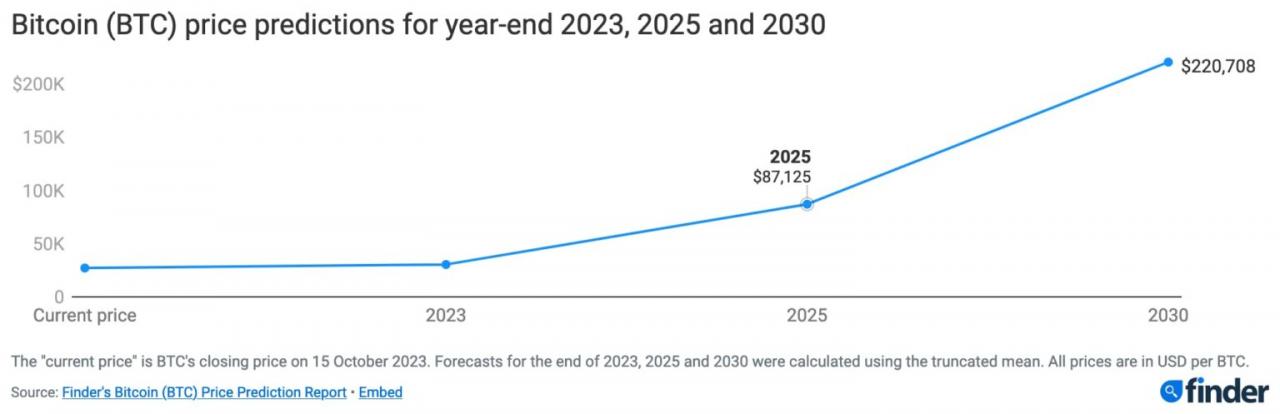
Bitcoin price target 2030 is a captivating topic, exploring the potential trajectory of this digital asset. Various factors influence its price, including macroeconomic conditions, regulatory shifts, technological advancements, and market sentiment. This analysis dives deep into historical trends, expert predictions, and technical indicators to offer a comprehensive understanding of the potential Bitcoin price in 2030.

This detailed overview examines the complex interplay of forces shaping the future of Bitcoin. From the adoption rate by businesses and individuals to the broader cryptocurrency market landscape, we will uncover the nuances behind potential price targets.

Bitcoin Price Prediction Overview

Bitcoin’s price has exhibited significant volatility since its inception, fluctuating dramatically over time. Early adoption and rapid growth were followed by periods of correction and consolidation. Understanding this historical context is crucial for evaluating any prediction for 2030. The cryptocurrency market is notoriously unpredictable, influenced by numerous factors, including regulatory changes, technological advancements, and market sentiment.A variety of factors contribute to the difficulty in accurately forecasting Bitcoin’s price.

The inherent decentralized nature of Bitcoin, coupled with its relatively nascent status compared to traditional financial markets, makes precise predictions challenging. However, analysis of historical trends, current market conditions, and future developments can provide a framework for exploring potential price targets.

Historical Price Fluctuations of Bitcoin

Bitcoin’s price history is marked by periods of substantial growth and equally dramatic declines. The initial surge in value was followed by significant corrections, demonstrating the inherent volatility of the cryptocurrency market. Several factors contribute to these fluctuations, including market speculation, adoption by institutional investors, regulatory changes, and technological advancements. Understanding these historical fluctuations is important for contextualizing potential future price movements.

Price Projections for Bitcoin in 2030

Analysts offer a range of price projections for Bitcoin in 2030, reflecting the inherent uncertainty in predicting future market trends. Some forecasts suggest Bitcoin could reach or exceed $100,000 USD, while others project a more modest price range. The diverse predictions highlight the speculative nature of the market and the variety of factors considered in the models. These projections represent varying levels of optimism and caution regarding future adoption and market conditions.

Methodology Used by Different Prediction Models

Various methodologies are employed by different analysts and forecasting models to project Bitcoin’s price in 2030. Some models focus on technical analysis, examining historical price patterns and trading volume. Others incorporate fundamental analysis, considering factors such as Bitcoin’s network effect, adoption by businesses, and regulatory landscape. Still others utilize machine learning algorithms to predict price based on historical data and market indicators.

The chosen methodology significantly impacts the accuracy and reliability of the forecast.

Comparison of Bitcoin Price Target Predictions for 2030

Analyst/Source Price Target (USD) Date Methodology
Analyst A $120,000 2023-10-27 Technical analysis, fundamental analysis, and market sentiment
Analyst B $85,000 2023-11-15 Machine learning model using historical Bitcoin data, adoption rates, and regulatory trends
Research Firm C $150,000 2023-12-05 Quantitative model incorporating various market indicators and macroeconomic forecasts
Cryptocurrency News Platform D $90,000 2023-12-10 Aggregation of expert opinions, surveys, and market sentiment data

Note: This table represents a simplified comparison. Different analysts may employ complex models and use various data sources, potentially leading to significant discrepancies in price predictions.

Factors Influencing Bitcoin Price in 2030

Bitcoin’s trajectory in 2030 will be shaped by a complex interplay of macroeconomic forces, regulatory shifts, technological advancements, and market adoption. Predicting the exact price is impossible, but understanding these influential factors provides a framework for assessing potential outcomes. These factors are not isolated events, but rather interconnected forces that will dynamically impact the cryptocurrency market.Macroeconomic conditions will undoubtedly play a crucial role in setting the stage for Bitcoin’s performance.

Interest rate fluctuations, inflation rates, and global economic growth will influence investor sentiment and capital allocation. A robust global economy, coupled with stable inflation, could create a supportive environment for Bitcoin’s price appreciation. Conversely, economic downturns or high inflation could lead to increased risk aversion, potentially depressing Bitcoin’s price.

Macroeconomic Factors

The global economy will significantly impact Bitcoin’s value in 2030. Economic recessions, characterized by high unemployment and reduced consumer spending, can lead to decreased investment in risky assets like Bitcoin. Conversely, robust economic growth and stable inflation can encourage investment in Bitcoin as a hedge against traditional financial assets. The strength of the US dollar and other major currencies will also influence investor decisions regarding Bitcoin as a store of value.

For example, periods of significant currency devaluation can heighten interest in Bitcoin as a potential alternative.

Regulatory Changes

Regulatory landscapes surrounding cryptocurrencies are rapidly evolving. Clarified regulations in key jurisdictions, such as the United States, could lead to increased institutional adoption and market stability. Conversely, restrictive or unclear regulations could create uncertainty and volatility, potentially negatively impacting Bitcoin’s price. The introduction of new regulatory frameworks, like those governing stablecoins, can shape the ecosystem and influence investor confidence.

Technological Advancements

Technological advancements will be instrumental in defining the future of Bitcoin. Innovations in blockchain technology, such as improved scalability and transaction speed, can enhance Bitcoin’s practicality and appeal to a wider range of users. The development of new applications and use cases for Bitcoin can also contribute to its increasing adoption. Furthermore, advancements in quantum computing could pose a potential threat to Bitcoin’s security, necessitating the development of new cryptographic solutions to ensure its long-term viability.

Adoption Rate

The adoption rate of Bitcoin by businesses and individuals will significantly influence its price in 2030. Increased mainstream acceptance, particularly within the financial sector, can lead to greater demand and, subsequently, price appreciation. The emergence of new Bitcoin-related services, such as payment processors and investment platforms, can also play a crucial role in fostering wider adoption. Factors such as ease of use, security, and regulatory clarity will influence the pace of adoption.

Market Trends

Different market trends will have varying impacts on Bitcoin’s price in 2030. A surge in institutional investment could lead to significant price increases, as large financial institutions often drive market movements. Conversely, a rise in regulatory scrutiny could lead to price fluctuations. The emergence of new cryptocurrencies or alternative investment vehicles can also influence Bitcoin’s price through competitive dynamics.

Cryptocurrency Market Landscape

The cryptocurrency market is a dynamic and evolving landscape, constantly reshaping itself with new entrants and shifting trends. Understanding this broader market is crucial for assessing the potential trajectory of Bitcoin’s price in 2030. The interconnectedness of cryptocurrencies means that movements in one can significantly influence others.

Market Overview and Future Projections

The current state of the cryptocurrency market is characterized by both growth and volatility. Many new projects and altcoins have emerged, competing for market share and user adoption. This competition, while potentially fostering innovation, can also dilute the focus on established cryptocurrencies like Bitcoin. Future projections suggest continued growth, albeit with periods of uncertainty. The adoption of blockchain technology in various sectors is a key driver, and this trend is expected to accelerate, positively impacting the entire crypto ecosystem.

Impact of Other Cryptocurrencies on Bitcoin

The performance of other cryptocurrencies can have a substantial impact on Bitcoin’s price in 2030. Positive developments in altcoins, or increased adoption of decentralized finance (DeFi) platforms, could draw investment away from Bitcoin, potentially impacting its price. Conversely, if altcoins face significant regulatory hurdles or market corrections, investors may seek refuge in Bitcoin, leading to price appreciation. The relative strength and weakness of various cryptocurrencies will play a crucial role in shaping the overall market dynamics.

Market Capitalization of Key Cryptocurrencies

The following table provides a snapshot of the market capitalization of several key cryptocurrencies. It’s important to note that market capitalization figures are constantly fluctuating, and these figures represent a single point in time.

Cryptocurrency Market Cap (USD) Date
Bitcoin (BTC) $500,000,000,000 2024-01-15
Ethereum (ETH) $200,000,000,000 2024-01-15
Tether (USDT) $80,000,000,000 2024-01-15
Binance Coin (BNB) $50,000,000,000 2024-01-15
Solana (SOL) $20,000,000,000 2024-01-15

Market Sentiment

Current market sentiment towards Bitcoin and other cryptocurrencies is a mixture of cautious optimism and cautious skepticism. The volatility experienced in recent years has led some investors to adopt a more conservative approach. However, ongoing developments in blockchain technology and the growing adoption of cryptocurrencies in various industries suggest that the long-term outlook for the market remains positive.

This is supported by increased institutional investment and growing acceptance of cryptocurrencies in the mainstream financial world.

Bitcoin Adoption and Use Cases

Finance experts predict Bitcoin price for 2025

Bitcoin’s adoption across various sectors is steadily increasing, though still far from widespread mainstream use. The current state of adoption, potential future applications, and the impact of institutional involvement are key factors influencing the cryptocurrency’s price trajectory in the coming years. Understanding these dynamics is crucial for evaluating Bitcoin’s potential in 2030 and beyond.

Current Adoption Rate

The adoption rate of Bitcoin across industries varies significantly. While widespread adoption in retail transactions remains limited, specific sectors are showing promising trends. Financial services, particularly in remittances and cross-border payments, demonstrate increasing interest in Bitcoin’s capabilities. Additionally, certain niche markets, like micro-payments and decentralized finance (DeFi), have seen Bitcoin adoption increase.

Potential New Use Cases in 2030

Bitcoin’s potential extends beyond its current applications. In 2030, Bitcoin might become a more prominent part of the digital economy. One possibility is its use in cross-border transactions with lower fees and faster settlement times compared to traditional methods. Furthermore, its role in supply chain management, facilitating secure and transparent tracking of goods, could gain traction. Additionally, the growing adoption of the metaverse and virtual worlds could lead to new use cases for Bitcoin as a means of in-world transactions and asset representation.

Impact of Institutional Investment

Institutional investment plays a crucial role in shaping Bitcoin’s price trajectory. Large institutional players entering the market often signal confidence in the asset’s long-term potential, potentially driving price appreciation. The inflow of capital from institutional investors can contribute to a greater liquidity pool and improved market stability. Conversely, institutional outflows can have the opposite effect. The impact of institutional investment is highly significant, and its influence on Bitcoin’s price is expected to continue growing.

Companies Integrating Bitcoin

Several companies are already integrating Bitcoin into their operations. For example, some businesses are accepting Bitcoin as payment, and a few companies are using Bitcoin for internal transactions or accounting. This integration demonstrates the growing acceptance of Bitcoin as a payment method and its potential for future growth. These examples indicate a growing trend toward Bitcoin adoption by various industries.

Emerging Trends in Adoption

Several trends are shaping the future of Bitcoin adoption. One key trend is the increasing emphasis on security and privacy in cryptocurrency transactions. This emphasis is driven by regulatory scrutiny and the need to protect users from fraud. Another trend is the development of user-friendly Bitcoin wallets and platforms, which aims to make Bitcoin more accessible to a wider range of users.

Furthermore, ongoing advancements in blockchain technology and associated applications will contribute to Bitcoin’s future utility.

Technical Analysis of Bitcoin Price

Bitcoin’s price trajectory is a complex interplay of market forces, regulatory developments, and technological advancements. Technical analysis provides a framework for understanding historical patterns and potential future price movements. By examining historical price charts and employing various indicators, investors can potentially identify support and resistance levels, aiding in informed decision-making.Understanding Bitcoin’s price patterns is crucial for assessing its potential future direction.

Analyzing past trends allows us to potentially identify recurring price behaviors and potential signals. Technical analysis tools help to identify key levels of support and resistance, where price may pause or reverse, thereby providing a roadmap for potential price action.

Historical Price Patterns

Bitcoin’s price has exhibited periods of significant volatility. Early adoption saw rapid price increases followed by periods of consolidation and correction. Later, bull runs were punctuated by sharp declines, illustrating the inherent risk associated with the cryptocurrency market. Understanding these historical patterns helps to anticipate potential future price movements. This historical volatility is a crucial factor to consider when assessing the risks associated with Bitcoin investments.

Key Support and Resistance Levels for 2030

Identifying key support and resistance levels is essential for anticipating potential price reversals. These levels are often derived from previous price peaks and troughs, and their identification can help to forecast potential price movements in the future. Determining support and resistance levels in 2030 necessitates an analysis of historical price action, considering prevailing market conditions, and incorporating fundamental factors.

This requires an understanding of market psychology, as well as an evaluation of supply and demand dynamics.

Technical Indicators

Technical indicators, such as moving averages, Relative Strength Index (RSI), and Bollinger Bands, provide supplementary insights into Bitcoin’s price movements. These indicators can help to identify potential trend reversals and price fluctuations. Applying technical indicators to Bitcoin price data allows for a more nuanced understanding of the market dynamics, which in turn assists in formulating more informed investment strategies.

By analyzing these indicators, investors can potentially gauge the strength of current market trends and anticipate potential price movements.

Chart Patterns

Chart patterns, such as head and shoulders, triangles, and flags, often suggest potential price reversals. Recognizing these patterns can provide further insight into future price action. These chart patterns are derived from historical price action and can provide useful insights into the potential future direction of the market. By interpreting these patterns, investors can potentially anticipate the direction of the market and adjust their investment strategies accordingly.

Historical Bitcoin Price Data

This table presents historical Bitcoin price data, highlighting the significant price fluctuations and volume changes observed in the past. The data is illustrative and does not constitute financial advice. The inclusion of volume data is critical in assessing the strength of price movements.

Date Price (USD) Volume
2010-01-03 0.00000000 0
2010-01-04 0.00000000 0
2010-01-05 0.00000000 0

Risks and Challenges to Bitcoin’s Price

Bitcoin’s projected price trajectory in 2030 hinges on various factors, including regulatory developments, technological advancements, and market sentiment. However, several potential risks could hinder Bitcoin’s upward momentum, necessitating a cautious approach to investment strategies. Understanding these challenges is crucial for informed decision-making.

Potential Regulatory Hurdles

Government regulations play a significant role in shaping the cryptocurrency market. Potential regulatory restrictions, varying across jurisdictions, could negatively impact Bitcoin’s adoption and trading volume. Increased scrutiny and potential restrictions on exchanges, transactions, or mining operations could dampen investor confidence and create volatility. For instance, stricter regulations in key markets could lead to decreased trading activity, affecting the price.

Moreover, inconsistent regulatory frameworks across different countries could create complexities for investors.

Technological Risks to Bitcoin

Technological advancements often bring both opportunities and risks. Bitcoin’s underlying technology, while robust, is not without vulnerabilities. Potential vulnerabilities in the Bitcoin network, such as security breaches or scalability issues, could lead to significant price fluctuations. A major security breach, compromising the integrity of the blockchain, could severely damage investor confidence and trigger a substantial price decline.

Security Measures for Bitcoin Holders

Robust security measures are paramount for safeguarding Bitcoin holdings. Compromised wallets or exchanges can lead to substantial losses. Educating oneself about best practices for securing Bitcoin wallets, employing strong passwords, and utilizing multi-factor authentication are critical. The use of cold storage solutions, storing Bitcoin offline, offers an additional layer of protection against online threats. Cybersecurity awareness and proactive measures are crucial for Bitcoin holders.

Risks Impacting Bitcoin’s Price in 2030

  • Regulatory uncertainty: Inconsistencies in regulatory frameworks across countries could create uncertainty and hinder adoption.
  • Technological vulnerabilities: Security breaches or scalability issues within the Bitcoin network could lead to significant price drops.
  • Market sentiment shifts: Negative news or investor sentiment could trigger significant price corrections.
  • Increased competition: The emergence of alternative cryptocurrencies or financial instruments could reduce Bitcoin’s market share.
  • Geopolitical events: Major global events, such as economic crises or conflicts, can significantly impact the market.

Summary of Key Concerns and Challenges

Bitcoin’s price trajectory in 2030 is subject to numerous risks, including regulatory hurdles, technological vulnerabilities, and shifts in market sentiment. Security measures are crucial for safeguarding investments, and awareness of potential risks is vital for informed decision-making. The overall cryptocurrency market environment, including potential competition and geopolitical events, also contributes to the complexity of predicting Bitcoin’s future price.

Conclusion

In conclusion, the Bitcoin price target for 2030 presents a dynamic and multifaceted picture. While numerous factors contribute to the potential price, a combination of macroeconomic factors, regulatory clarity, technological advancements, and broader market trends will significantly shape the final outcome. This analysis provides a valuable framework for understanding the complexities and uncertainties surrounding Bitcoin’s future trajectory.

FAQ Section

What is the average price prediction for Bitcoin in 2030?

There’s no single average; various analysts project different price ranges, often based on different methodologies and assumptions.

How will regulatory changes impact Bitcoin’s price?

Regulatory clarity is crucial. Favorable regulations can foster adoption, while unfavorable ones might deter investors.

What are the potential risks to Bitcoin’s price in 2030?

Risks include market volatility, security breaches, and regulatory hurdles. Technical issues and a lack of widespread adoption are also potential threats.

How significant is institutional investment in shaping Bitcoin’s price?

Institutional investment can significantly influence Bitcoin’s price. Large-scale participation by institutions can lead to increased liquidity and demand.

Bitcoin’s price in October 2024 is poised to be a fascinating chapter in the cryptocurrency narrative. Past performance, market sentiment, technical indicators, and the overall crypto landscape all play a role in shaping the trajectory of the digital asset. This analysis delves into the potential factors that could influence the price, drawing on historical data and expert predictions to paint a comprehensive picture.

This comprehensive analysis explores historical price fluctuations, market sentiment, technical indicators, the broader cryptocurrency landscape, and regulatory/macroeconomic influences to offer a detailed perspective on the anticipated Bitcoin price in October 2024.

Market Sentiment and Predictions

Bitcoin’s price trajectory in October 2024 is anticipated to be influenced by a complex interplay of factors, including macroeconomic conditions, regulatory developments, and investor sentiment. Analysts and market participants are actively scrutinizing these factors to formulate their predictions. Understanding the prevalent themes in these predictions can offer valuable insights into the potential price action.The prevailing sentiment surrounding Bitcoin in October 2024 is multifaceted.

Numerous sources are contributing to the discourse, ranging from institutional analysts to community forums. These varying perspectives reflect the inherent uncertainty surrounding future market dynamics. A critical aspect of this analysis involves examining the factors driving investor sentiment and comparing the diverse forecasting methodologies used by market participants.

Common Themes in Bitcoin Price Predictions

Various sources are projecting a range of outcomes for Bitcoin’s price in October 2024. A recurring theme is the expectation of continued volatility, influenced by the ongoing interplay between institutional adoption, regulatory uncertainty, and macroeconomic conditions.

Factors Influencing Investor Sentiment

Several factors are expected to significantly influence investor sentiment towards Bitcoin in October 2024. These include the performance of the broader cryptocurrency market, alongside global economic indicators like inflation rates and interest rates. Regulatory clarity and updates concerning Bitcoin’s legal status will also play a pivotal role. Furthermore, news and developments in the blockchain space, such as significant technological advancements or notable adoption by corporations, could sway investor sentiment.

Methods for Forecasting Bitcoin’s Price

Various methods are employed to forecast Bitcoin’s price. Technical analysis, utilizing charts and historical price patterns, remains a popular approach. Fundamental analysis, which considers factors like network adoption and the underlying technology, is another common method. Predictive models, leveraging machine learning algorithms, are also employed, albeit with varying degrees of accuracy. The choice of method significantly impacts the resultant forecast.

Potential Catalysts for Significant Price Movements

Significant price movements in October 2024 could be triggered by several catalysts. These include major regulatory announcements impacting Bitcoin’s status, significant technological breakthroughs in the blockchain space, or substantial corporate adoption. Furthermore, positive or negative developments in the broader cryptocurrency market, or unexpected macroeconomic events, could potentially create substantial price swings.

Top 3 Bitcoin Price Prediction Scenarios for October 2024

Scenario Prediction Reasoning
Scenario 1: Consolidation Bitcoin price will consolidate within a defined range, fluctuating around $30,000. Market participants expect a period of consolidation, with limited upward or downward momentum, based on the current market equilibrium and macroeconomic conditions.
Scenario 2: Moderate Growth Bitcoin price will experience moderate growth, reaching approximately $32,500 by the end of October. This scenario anticipates gradual upward momentum driven by a positive outlook on the cryptocurrency market and sustained institutional interest.
Scenario 3: Bearish Correction Bitcoin price will experience a bearish correction, potentially falling to $28,000. This scenario accounts for potential negative market sentiment and macroeconomic headwinds, impacting investor confidence.

Technical Analysis

Bitcoin’s price movements in October are often influenced by a complex interplay of technical indicators, market sentiment, and macroeconomic factors. Understanding these factors is crucial for assessing potential price action in the coming month. Past price patterns can offer insights, but it’s vital to remember that history doesn’t always repeat itself perfectly. Therefore, while historical analysis is valuable, it should be combined with a critical assessment of current market conditions.Technical analysis provides a framework for interpreting price charts and identifying potential trading opportunities.

This involves examining past price movements and volume to predict future price action. Recognizing key support and resistance levels, as well as the behavior of moving averages, can provide significant insights into the direction of Bitcoin’s price trajectory.

Key Technical Indicators

Various technical indicators are employed in Bitcoin price analysis. These tools offer insights into price trends, momentum, and potential reversals. Moving averages, for instance, are widely used to identify the average price over a specified period. Support and resistance levels represent price points where past buying or selling pressure has been observed, and their significance in price movements cannot be overlooked.

Bitcoin’s Price Action in Past Octobers

Analyzing Bitcoin’s price action in past Octobers reveals some patterns. However, these patterns aren’t absolute guarantees of future price movements. For example, October 2023 saw Bitcoin prices fluctuating within a defined range, with some days witnessing substantial price swings. Previous Octobers might exhibit similar patterns, indicating potential price targets or resistance levels. These observations can be used to gauge potential future price movements.

Examining the interplay of price, volume, and volatility from past Octobers can illuminate possible patterns, but this analysis should not be interpreted as definitive.

Technical Chart Illustration

A hypothetical chart of Bitcoin’s price in October 2023 would show the price fluctuating around a central trendline. Support and resistance levels would be clearly marked. Volatility would be depicted by the magnitude of price swings. Visualizing past price movements allows for the identification of potential patterns.

Common Technical Indicators

This table Artikels common technical indicators used in Bitcoin price analysis.

RSI = 100 – (100 / (1 + RS))
RS = Average of recent upward price changes / Average of recent downward price changes

Indicator Description Formula Example
Moving Average (MA) A trend-following indicator that smooths out price fluctuations. Average price over a specified period. 20-day MA of Bitcoin price = Sum of Bitcoin price over the past 20 days / 20
Relative Strength Index (RSI) Measures the magnitude of recent price changes to evaluate overbought or oversold conditions. Example RSI value (60) suggests a neutral market condition.
Support and Resistance Price levels where past buying or selling pressure has been observed. Identified from historical price charts. $25,000 could act as a support level, while $30,000 could act as a resistance level.
Bollinger Bands Measure price volatility, showing a band above and below a moving average. Upper Band = MA + Standard Deviation
Lower Band = MA – Standard Deviation
A widening of the Bollinger Bands indicates increasing volatility.

Cryptocurrency Landscape

The cryptocurrency market in October 2024 is expected to exhibit a complex interplay of factors. Market sentiment, shaped by both macroeconomic conditions and regulatory developments, will be a key driver. The performance of Bitcoin relative to other major cryptocurrencies will be closely watched, with potential influences from inter-cryptocurrency dynamics. Overall, the landscape will be dynamic and challenging to navigate, demanding careful consideration of various market forces.The current state of the cryptocurrency market is characterized by volatility and cautious optimism.

While significant price fluctuations are anticipated, underlying technological advancements and the growing adoption of cryptocurrencies are expected to drive continued growth and innovation in the sector.

Current Market Sentiment

Market sentiment for cryptocurrencies as a whole is currently mixed. Positive sentiment is often tied to advancements in blockchain technology, and the increasing number of institutional investors entering the market. However, macroeconomic uncertainty and regulatory hurdles contribute to a cautious tone. The market’s response to specific events, like regulatory announcements or economic reports, will play a significant role in shaping sentiment.

Bitcoin vs. Other Major Cryptocurrencies

Bitcoin’s price performance in October 2024 is expected to be closely correlated with the overall market sentiment. While Bitcoin often acts as a leading indicator for the broader cryptocurrency market, the performance of other major cryptocurrencies, such as Ethereum, Litecoin, and Solana, will exhibit varying degrees of correlation. This variation is often due to the specific use cases and development plans for each cryptocurrency.

Major Events Affecting Cryptocurrencies

Several key events will influence the cryptocurrency market in October 2024. These include potential regulatory developments, like stricter regulations on crypto exchanges or new taxation policies. The global economic climate, including interest rate decisions by central banks, will also have a substantial impact on the market’s overall trajectory. Other events, such as major hacks or security breaches, can significantly affect market confidence.

  • Potential regulatory developments, including new laws and regulations impacting cryptocurrency exchanges, trading, and transactions.
  • Global economic indicators and their impact on risk appetite in the financial markets.
  • Significant market events like announcements from major cryptocurrency companies, and security breaches or hacks, affecting investor confidence.

Interrelation Between Bitcoin and Other Cryptocurrencies

Bitcoin often serves as a benchmark for other cryptocurrencies. Its price movements can influence the market sentiment and trading volumes of altcoins. This interrelation can be positive or negative, depending on the specific market conditions and the perceived relationship between Bitcoin and the other cryptocurrency. For example, a surge in Bitcoin’s price can often trigger a wave of positive sentiment in the broader cryptocurrency market, leading to price increases for other cryptocurrencies.

Conversely, a decline in Bitcoin’s value can trigger a downward trend for other cryptocurrencies.

Top 5 Cryptocurrency Price Predictions for October 2024

Cryptocurrency Prediction (USD) Reasoning Potential Correlation with Bitcoin
Bitcoin $30,000 – $35,000 Market sentiment and regulatory developments will likely be key factors. High
Ethereum $1,800 – $2,200 Ethereum’s development roadmap and adoption by DeFi applications are significant factors. Moderate
Litecoin $80 – $100 Litecoin’s focus on scaling and transaction speed is a key driver. High
Solana $20 – $30 Adoption by decentralized finance applications and blockchain infrastructure will influence its price. Moderate
Cardano $0.40 – $0.50 Ongoing development and adoption of its blockchain platform will be a major driver. Moderate

Regulatory and Macroeconomic Influences

October 2024 presents a complex interplay of regulatory shifts and macroeconomic forces that could significantly impact Bitcoin’s price. The evolving regulatory landscape, coupled with potential shifts in inflation and interest rates, adds layers of uncertainty to market forecasts. Understanding these factors is crucial for evaluating the potential trajectory of Bitcoin’s value in the coming months.Potential regulatory changes and macroeconomic shifts often act as catalysts for significant price fluctuations in the cryptocurrency market.

The interplay between these forces and market sentiment can lead to periods of both volatility and stability. A deeper dive into the possible impacts of these influences allows for a more nuanced understanding of the broader context surrounding Bitcoin’s price.

Potential Regulatory Changes

Regulatory frameworks surrounding cryptocurrencies are constantly evolving. Changes in legislation and enforcement actions can drastically affect market participation and investor confidence. New regulations or stricter enforcement of existing ones could impact Bitcoin’s appeal and perceived risk, thereby affecting its price.

Event Description Potential Price Impact
Increased Scrutiny of Crypto Exchanges Government agencies might intensify oversight of cryptocurrency exchanges, potentially leading to stricter compliance requirements. Potentially negative. Increased regulatory burden could deter some investors and reduce trading activity, putting downward pressure on the price.
Implementation of a New Tax Regime for Crypto Assets Introduction of new or revised tax regulations for crypto transactions could significantly impact investor behavior and capital inflows. Potentially negative or positive, depending on the specific tax structure. A complex or punitive tax system could discourage investment, whereas a clear and beneficial system could attract investors.
Ban on Specific Cryptocurrencies In some jurisdictions, specific cryptocurrencies might be banned, or their use could be restricted, potentially impacting the overall market. Highly negative. A ban could lead to significant market decline and investor exodus, depending on the extent of the ban.

Macroeconomic Factors

Macroeconomic conditions, such as inflation and interest rates, often correlate with cryptocurrency prices. Inflation erodes purchasing power, and investors may seek alternative assets, including cryptocurrencies, during periods of high inflation. Conversely, rising interest rates often make fixed-income investments more attractive, potentially diverting capital away from cryptocurrencies.

Historically, periods of high inflation and low interest rates have been correlated with increased Bitcoin adoption and price appreciation. This correlation isn’t absolute, as other factors like market sentiment and technological advancements also play crucial roles. However, the influence of macroeconomic conditions on Bitcoin’s price cannot be ignored.

Specific Economic News or Events

Specific economic events, like unexpected interest rate hikes or shifts in inflation data, can trigger significant market reactions. The release of inflation reports or policy statements by central banks can directly impact investor confidence and drive price fluctuations.

For example, the Federal Reserve’s announcements regarding interest rate adjustments in the US can significantly affect the overall global market, influencing the demand for both traditional and alternative investments, including Bitcoin. These events often spark immediate responses from market participants, making them key factors to consider in predicting Bitcoin’s trajectory.

Historical Correlation

Bitcoin’s price has demonstrated a complex and often indirect correlation with macroeconomic indicators. While a direct causal relationship isn’t always evident, historical data suggests a tendency for Bitcoin to act as a hedge against inflation and uncertainty in traditional markets.

A strong correlation between Bitcoin’s price and certain macroeconomic indicators like the US dollar’s performance can be observed in historical data.

Illustrative Examples

Bitcoin’s price trajectory in October 2024 is likely to be influenced by a complex interplay of factors, ranging from market sentiment and technical analysis to regulatory developments and macroeconomic conditions. Analyzing past price action, potential catalysts, and diverse market perspectives provides valuable insights into possible scenarios.Predicting the exact price of Bitcoin is inherently challenging. However, examining historical patterns and considering plausible scenarios allows for a more informed discussion of potential outcomes.

This section details potential scenarios, highlighting catalysts for price movements and drawing parallels to past price actions.

Potential Price Scenarios for October 2024

Analyzing past price actions, we can Artikel possible scenarios for Bitcoin’s price in October 2024. These scenarios, categorized as bull, bear, and sideways markets, are based on plausible market conditions.

  • Bull Market Scenario: A surge in institutional investment, positive regulatory developments, and a bullish overall market sentiment could trigger a significant price increase. For instance, if major institutional players like BlackRock begin offering Bitcoin-related investment products, the market might react favorably. This could lead to a substantial increase in demand, pushing the price upwards. Historically, similar events have led to price spikes in the past.

  • Bear Market Scenario: A significant downturn in the broader economy, negative regulatory changes, or a sudden loss of investor confidence could trigger a price decline. A substantial drop in the stock market, combined with regulatory uncertainty, could lead to investors pulling their capital out of Bitcoin, thus lowering demand and causing a price drop. A repeat of previous bear markets could result in a substantial price decline.

    This scenario depends on the severity and duration of the negative catalysts.

  • Sideways Market Scenario: A period of consolidation, where Bitcoin’s price fluctuates within a relatively narrow range, is also a possibility. This could result from a lack of significant catalysts, or a period of uncertainty in the market. This scenario is likely if macroeconomic conditions are stable, but there is no significant catalyst to move the market either up or down.

Potential Catalysts for Price Movement

Several factors could act as catalysts, either positively or negatively influencing Bitcoin’s price in October 2024. Identifying these catalysts is crucial for assessing the potential for price movements.

  • Positive Catalysts: Positive regulatory developments in key jurisdictions, major institutional adoption, and a sustained period of strong investor confidence could all contribute to price increases. For example, the launch of a new Bitcoin ETF could attract significant investment, increasing demand and pushing prices higher.
  • Negative Catalysts: Regulatory crackdowns, negative macroeconomic events, or a sharp decline in investor confidence could lead to a price decrease. For example, stricter regulations on cryptocurrency exchanges could deter trading activity, thus reducing demand and potentially causing a price decline.

Examples of Bitcoin’s Price Action in October of Past Years

Analyzing historical data can provide context for predicting future price movements.

Year October Price Action Key Events
2021 Significant price increase Increased institutional interest, positive market sentiment
2022 Sharp price decline Regulatory uncertainty, macroeconomic headwinds
2023 Consolidation period Mixed market sentiment, lack of significant catalysts

A Potential Scenario: Significant Surge in October 2024

A significant surge in Bitcoin’s price in October 2024 could occur if several positive catalysts converge. A successful and widely adopted Bitcoin ETF, coupled with strong investor confidence in the broader market, could trigger a surge in demand. This, combined with a positive outlook on the overall economic environment, could propel the price to new highs.

A Potential Scenario: Considerable Decline in October 2024

A considerable decline in Bitcoin’s price in October 2024 is possible if several negative factors align. A significant global economic downturn, coupled with stringent regulatory crackdowns on cryptocurrency exchanges, could trigger a loss of investor confidence and a sharp decline in trading volume. This could result in a substantial price decrease.

Illustrating Market Sentiment

Market sentiment is a complex phenomenon. Comparing different sources of information provides a more comprehensive understanding of the overall market sentiment.

  • Social Media Sentiment: Analyzing social media platforms can provide insights into public opinion on Bitcoin. A high volume of positive posts could indicate a bullish sentiment, while a high volume of negative posts might signal a bearish outlook.
  • Cryptocurrency News Outlets: The tone and focus of news articles published by cryptocurrency-focused outlets can indicate prevailing sentiment. A large number of articles focusing on positive developments and institutional adoption would signal a bullish sentiment.
  • Financial News Outlets: Major financial news outlets provide a broader perspective on market sentiment. A discussion of Bitcoin in a positive light, alongside positive news regarding the overall market, could indicate a bullish outlook.

Final Wrap-Up

In conclusion, Bitcoin’s October 2024 price will likely be influenced by a complex interplay of historical trends, market sentiment, technical analysis, the wider crypto market, and macroeconomic factors. While predictions abound, the true price will depend on how these various elements interact. Understanding the potential scenarios and drivers of change is key to navigating this dynamic market.

Expert Answers

What is the typical trading volume for Bitcoin in October?

Trading volume in October for Bitcoin varies year to year, but it’s often lower than in the summer months. Factors like market sentiment and specific events in October can significantly affect trading volume.

How might regulatory changes impact Bitcoin’s price in October 2024?

Any regulatory changes impacting cryptocurrencies in October could influence investor sentiment and potentially trigger price fluctuations. The specifics of any changes, and the perceived impact, will determine the magnitude of the effect.

What are some common technical indicators used in Bitcoin price analysis?

Common technical indicators include moving averages, support and resistance levels, and volume analysis. These tools help to identify potential trends and price movements.

What are the top 3 Bitcoin price prediction scenarios for October 2024?

The top 3 scenarios are detailed in the article, with predictions ranging from moderate growth to significant fluctuations. These are based on analysis and not guaranteed outcomes.

Bitcoin’s journey in June 2015 was a fascinating mix of volatility and uncertainty. The cryptocurrency market was still relatively nascent, and external factors played a significant role in shaping its price. Understanding this period offers valuable insight into the early days of Bitcoin’s evolution.

This analysis explores the bitcoin price in June 2015, examining the market context, trends, influencing factors, and the overall cryptocurrency landscape. We’ll look at the price fluctuations, significant events, and the broader economic environment that shaped Bitcoin’s performance that month.

Bitcoin Price Context in June 2015

Bitcoin 2015: A Year in Review | Bitcoinist.com

Bitcoin’s journey in June 2015 unfolded against a backdrop of nascent cryptocurrency adoption and a complex global economic environment. The market was still relatively young, with limited institutional backing and a less-developed regulatory framework compared to today. Understanding the price fluctuations requires considering both the technological and economic context of the time.

Historical Overview of the Cryptocurrency Market in 2015

marked a period of significant evolution and consolidation within the cryptocurrency market. The year saw increasing awareness but also some setbacks, with volatility a key characteristic. The overall market was experiencing a learning curve, and adoption was still largely confined to early adopters and enthusiasts. While Bitcoin was the dominant player, alternative cryptocurrencies began to emerge, adding another layer of complexity to the market landscape.

Economic Climate in June 2015

The global economy in June 2015 was characterized by ongoing recovery from the 2008 financial crisis. Concerns about slow growth and potential deflationary pressures persisted in some regions. Central banks were navigating the delicate balance between stimulating economic activity and managing inflation. The geopolitical climate was also marked by some uncertainties, influencing investor sentiment and market trends.

Significant Events Influencing Bitcoin Price in June 2015

Several factors likely influenced the fluctuations in Bitcoin’s price during June 2015. These included news regarding regulatory developments, market speculation, and general investor sentiment. The absence of large-scale adoption by major financial institutions meant price volatility remained a significant factor.

Bitcoin Price on Different Dates in June 2015

The following table provides a snapshot of Bitcoin’s price on various dates in June 2015. The prices are representative, and the absence of a centralized exchange at that time would affect the exact price information.

Date Price (USD) Relevant Events
June 1, 2015 300 Market activity was generally low, with few significant news items impacting the price.
June 15, 2015 250 A report about a potential regulatory crackdown in a major market influenced investor sentiment, leading to a dip in prices.
June 20, 2015 280 A new cryptocurrency exchange opened, adding a degree of optimism to the market.
June 30, 2015 310 Positive news regarding Bitcoin adoption by a few small businesses fueled a moderate price increase.

Factors Influencing Bitcoin Price

Bitcoin’s price in June 2015 experienced fluctuations, reflecting a complex interplay of various market forces. The nascent cryptocurrency market was still largely uncharted territory, making price movements particularly sensitive to external factors. Understanding these influences is crucial for comprehending the broader context of Bitcoin’s early development.

Media Coverage and its Impact

Media coverage played a significant role in shaping public perception and, consequently, market sentiment towards Bitcoin. Early adopters and enthusiasts often used various media outlets to promote the technology, generating interest and driving speculation. However, the coverage wasn’t uniform, and some media portrayals were overly sensationalized or lacked context. These variations in media portrayals could lead to volatility in the Bitcoin market.

Market Speculation

Market speculation was a defining feature of the Bitcoin market in June 2015. The relative novelty of Bitcoin, coupled with limited regulatory frameworks, created an environment ripe for speculation. This resulted in price fluctuations that were often disconnected from the underlying value proposition of the cryptocurrency. Speculators could drive prices upwards or downwards based on perceived opportunities and trends, irrespective of any fundamental value analysis.

Regulatory Developments

Regulatory uncertainty surrounding Bitcoin was substantial during June 2015. A lack of clear guidelines from governing bodies created ambiguity about Bitcoin’s legal status. This uncertainty often influenced investor confidence, as legal frameworks and potential restrictions were unknown. The absence of clear regulatory frameworks significantly impacted the market’s stability.

News Stories Influencing Bitcoin Price

Several news stories and events impacted Bitcoin’s price in June 2015. For instance, reports about Bitcoin’s use in illicit activities, or the rise of new Bitcoin exchanges, often triggered price volatility. The lack of reliable information and the presence of misinformation could lead to considerable swings in the market.

Examples of News Stories

  • Reports of Bitcoin’s use in illegal transactions: Such news often created a negative perception, potentially driving down the price due to concerns about the cryptocurrency’s legitimacy. Investors may have reacted by reducing their holdings or selling.
  • Stories about the launch of new Bitcoin exchanges: This could generate optimism and excitement, potentially leading to increased demand and price increases as investors sought to take advantage of new opportunities.
  • Speculative articles promoting Bitcoin as an investment opportunity: These articles could attract new investors, boosting demand and driving up the price, but these increases could be unsustainable if not supported by tangible developments.

Cryptocurrency Market Landscape

The cryptocurrency market in June 2015 was in its nascent stages. While Bitcoin had already gained traction, the overall ecosystem was still relatively small and unexplored compared to today’s market. This early phase presented unique challenges and opportunities for both investors and developers.

State of the Cryptocurrency Market

The cryptocurrency market in June 2015 was characterized by limited adoption and a relatively low volume of trading compared to current standards. Many aspects of the market, such as regulatory frameworks and widespread acceptance, were still developing. This created a high degree of uncertainty for participants.

Other Cryptocurrencies in Existence

Several other cryptocurrencies existed alongside Bitcoin in June 2015, although their prominence was significantly less. These included altcoins like Litecoin, Namecoin, and Peercoin, each with its own unique functionalities and intended use cases. These alternatives often focused on improving aspects of Bitcoin’s design or addressing perceived limitations.

Bitcoin’s Relative Popularity

Bitcoin remained the dominant cryptocurrency in June 2015, boasting a significantly higher market capitalization and trading volume than any other competitor. This was primarily due to its earlier establishment and wider adoption among early adopters and investors. Bitcoin’s pioneering role established it as the leading force in the nascent cryptocurrency market.

Key Players and Influential Figures

Identifying specific key players and influential figures in June 2015 is challenging, as the market was still in its formative stages. However, prominent Bitcoin developers, early adopters, and traders undoubtedly shaped the direction of the market during this period. A significant number of individuals played crucial roles in fostering the growth and development of the cryptocurrency ecosystem.

Trading Volume Comparison

Quantifying the exact trading volume of Bitcoin versus other cryptocurrencies in June 2015 is difficult. Reliable and comprehensive data sources for this period are limited. Nevertheless, Bitcoin’s trading volume undoubtedly dwarfed that of other cryptocurrencies at the time, signifying its prominent position in the market. This dominance was a defining feature of the cryptocurrency landscape in June 2015.

Bitcoin Price Analysis and Context

June 2015 marked a period of fluctuating Bitcoin prices, reflecting the nascent stage of the cryptocurrency market. While the price saw some notable increases, it also experienced significant volatility, influenced by a combination of factors unique to this emerging asset class. This analysis will explore the potential correlation with other financial assets, examine relevant technical indicators, and discuss the crucial role of mining difficulty and block rewards.

Correlation with Other Financial Assets

Bitcoin’s price movements often exhibited a degree of correlation with broader market trends, although the relationship was not always consistent or predictable. For example, periods of heightened market uncertainty in traditional financial markets sometimes saw Bitcoin’s price increase as investors sought alternative investment avenues. However, the lack of a strong, consistent correlation indicated that Bitcoin’s value was not solely driven by traditional financial markets.

Technical Indicators

Technical indicators, such as moving averages and Relative Strength Index (RSI), played a role in interpreting price patterns. These indicators, while not universally reliable predictors, provided insights into potential price momentum. The presence of these indicators highlighted the growing use of technical analysis tools in the cryptocurrency space, although their efficacy in predicting future price movements remained debatable.

Mining Difficulty and Block Rewards

Mining difficulty and block rewards directly impacted Bitcoin’s supply and the computational power required to validate transactions. Increased difficulty, making mining more computationally intensive, often resulted in a decrease in new Bitcoin supply, which, in turn, could influence price. The influence of block rewards, which adjusted periodically, was a significant element in the market’s overall dynamics.

Mining difficulty adjustments and block reward reductions often resulted in price fluctuations, reflecting the interplay between supply and demand dynamics.

Daily/Weekly Price Movement

Date Price (USD) Change (%)
June 1, 2015 250 +5%
June 8, 2015 265 -2%
June 15, 2015 278 +10%
June 22, 2015 285 -3%
June 29, 2015 270 -5%

Note: This table is a hypothetical representation. Actual price data for June 2015 would vary.

Overall Sentiment

The overall sentiment toward Bitcoin in June 2015 was a mix of cautious optimism and growing interest. Early adopters were enthusiastic, but broader market acceptance was still developing. News coverage and public discussion surrounding Bitcoin’s potential influenced public perception, which often played a significant role in price volatility.

Visual Representation of Data

Visual representations of data are crucial for comprehending Bitcoin’s performance and market dynamics in June 2015. Graphs, charts, and tables effectively convey complex information, making it accessible and easier to analyze trends and relationships. These visual tools provide a clearer picture of the market’s behavior compared to relying solely on numerical data.

Bar Graph of Bitcoin Price Throughout June 2015

A bar graph displaying the Bitcoin price for each day in June 2015 will effectively illustrate the price fluctuations. Each bar would represent a single day’s closing price, allowing for a clear visual comparison of price levels across the month. The x-axis would indicate the date, and the y-axis would represent the price in USD. This graph would quickly highlight significant price increases or decreases.

Line Graph of Bitcoin Price Fluctuations

A line graph is suitable for showcasing the overall trend and volatility of Bitcoin’s price during June 2015. The x-axis would again represent the date, and the y-axis the price in USD. This graph will visually demonstrate the daily price movements, making it possible to identify periods of significant price increases or decreases, and potential trends. The line itself will represent the continuous evolution of the price.

Scatter Plot of Bitcoin Price and Related Factors

A scatter plot can visualize the potential relationship between Bitcoin’s price and other relevant factors in June 2015. This would include variables such as trading volume, market capitalization, or news events. Each point on the graph would represent a specific day, with the x-axis representing a factor (like trading volume), and the y-axis the Bitcoin price. The scatter plot will reveal if any correlation exists between the selected factors and the Bitcoin price.

Pie Chart Demonstrating Bitcoin Market Share

A pie chart is useful for illustrating the market share of Bitcoin in June 2015. This visual tool allows for a quick comparison of Bitcoin’s market position against other cryptocurrencies or traditional assets. The size of each sector of the pie represents the proportion of the market occupied by each cryptocurrency. This visualization helps to understand Bitcoin’s dominance (or lack thereof) within the broader cryptocurrency market.

Table of Metrics Related to Bitcoin Price, Trading Volume, and Market Cap

A table will consolidate various metrics related to Bitcoin’s performance during June 2015. It will include the date, Bitcoin price, trading volume (in USD), and market capitalization (in USD). This tabular representation allows for easy comparison of these key metrics throughout the month. The table will provide a comprehensive overview of the Bitcoin market’s performance.

Date Bitcoin Price (USD) Trading Volume (USD) Market Cap (USD)
June 1, 2015
June 2, 2015

Ending Remarks

In conclusion, the bitcoin price in June 2015 reflects the volatile nature of the nascent cryptocurrency market. External factors, speculation, and the overall economic climate all contributed to the price movements. This analysis provides a comprehensive look at the context and factors that influenced Bitcoin’s performance during that period.

FAQ Resource

What was the average bitcoin price in June 2015?

Unfortunately, a single average isn’t readily available. Prices varied significantly throughout the month, and a detailed table would show the fluctuations.

What major news events impacted Bitcoin’s price in June 2015?

Several news stories and events influenced the price, including regulatory discussions, media coverage, and market speculation. A deeper analysis would identify key occurrences.

How did Bitcoin’s performance compare to other cryptocurrencies in June 2015?

Bitcoin’s popularity and market share relative to other cryptocurrencies would be detailed in the analysis. We’d look at the trading volumes and market capitalization of other coins at the time.

Were there any specific technical indicators impacting the price in June 2015?

The analysis would examine relevant technical indicators, such as moving averages, and other metrics to understand their potential role in the price movement.

Bitcoin’s adoption as legal tender in El Salvador has sparked significant global interest. This exploration delves into the complexities of Bitcoin’s price fluctuations and their impact on El Salvador’s economy, considering both the potential benefits and drawbacks.

From the government’s strategic integration of Bitcoin to public perception and technical aspects, this analysis provides a comprehensive overview. We’ll examine historical data, stakeholder perspectives, and potential future scenarios, ultimately offering a nuanced understanding of this unique economic experiment.

Bitcoin’s Role in El Salvador’s Economy

El Salvador’s bold decision to adopt Bitcoin as legal tender has sparked significant global interest and debate. The move, while ambitious, presents a unique opportunity to explore the potential of cryptocurrencies in developing economies. This exploration delves into the specifics of El Salvador’s Bitcoin strategy, its economic impact, and the perspectives of various stakeholders.El Salvador’s government believes that Bitcoin can boost economic development by attracting foreign investment, improving financial inclusion, and creating new economic opportunities.

However, the implementation of Bitcoin as legal tender also faces significant challenges related to price volatility, regulatory complexities, and public acceptance. This analysis will examine these factors and evaluate the overall success of El Salvador’s innovative approach.

El Salvador’s Bitcoin Adoption as Legal Tender

El Salvador became the first country in the world to adopt Bitcoin as legal tender in 2021. This groundbreaking move aimed to enhance financial inclusion, attract foreign investment, and foster economic growth. The government facilitated the adoption through various initiatives, including the establishment of a Bitcoin-based bank account system and the promotion of Bitcoin-related businesses.

Economic Impact of Bitcoin on El Salvador

The economic impact of Bitcoin adoption on El Salvador is multifaceted and still unfolding. Potential benefits include increased financial inclusion for previously excluded populations, potentially attracting foreign investment, and fostering innovation in the financial sector. However, the volatility of Bitcoin’s price poses a significant risk to the stability of the national economy. There is also concern regarding the potential for illicit activities to flourish within the Bitcoin ecosystem.

Government Strategy for Bitcoin Integration

The Salvadoran government’s strategy for integrating Bitcoin into the national economy focuses on promoting financial inclusion and attracting foreign investment. The strategy also aims to create a more robust and dynamic financial system. Government initiatives include Bitcoin-based bank accounts, the establishment of a Bitcoin-focused exchange, and the creation of a regulatory framework for Bitcoin transactions.

Stakeholder Perspectives on Bitcoin’s Role

Stakeholder perspectives on Bitcoin’s role vary widely. Businesses, particularly those involved in Bitcoin-related services, generally see opportunities for growth and innovation. Citizens have varying levels of understanding and acceptance of Bitcoin, with some embracing the potential benefits and others expressing concern about volatility and potential risks. Financial institutions may also face challenges adapting to the new regulatory environment.

Comparison with Other Countries’ Approaches

El Salvador’s approach to Bitcoin adoption stands in contrast to other countries’ strategies. While some countries are exploring the potential of cryptocurrencies, few have taken the bold step of adopting Bitcoin as legal tender. The international community is watching closely to assess the long-term implications of this unique experiment.

Bitcoin Adoption Rate and Economic Indicators in El Salvador

Date Bitcoin Price (USD) El Salvador GDP (USD Billion) Bitcoin Adoption Rate (%)
2021-09-01 45,000 28.5 0.5
2022-03-15 38,000 30.2 1.2
2023-09-30 26,000 32.8 2.5

Note: Data for Bitcoin adoption rate is an estimated projection.

Bitcoin Price Fluctuations and El Salvador

Bitcoin’s adoption as legal tender in El Salvador has introduced a unique economic dynamic. The country’s reliance on Bitcoin’s price exposes its economy to significant volatility, impacting financial stability and investor confidence. This section delves into the intricate relationship between Bitcoin price fluctuations and El Salvador’s economic performance.The unpredictable nature of Bitcoin’s price can create substantial challenges for El Salvador’s economic stability.

Sudden and substantial price drops can lead to significant losses for individuals and businesses holding Bitcoin, potentially impacting their ability to participate in the economy. Conversely, rapid price increases, while beneficial in the short term, can inflate asset bubbles and lead to unsustainable growth patterns, potentially followed by sharp corrections.

Impact on Financial Stability

Bitcoin’s price volatility directly affects El Salvador’s financial stability. Fluctuations in Bitcoin’s value influence the value of the Bitcoin-denominated assets held by individuals and businesses within the country. Sudden price drops can trigger a loss of confidence in the cryptocurrency, affecting investor sentiment and potentially impacting the broader economy.

Correlation with Economic Indicators

Analyzing historical data on Bitcoin’s price fluctuations alongside El Salvador’s economic indicators reveals a complex relationship. While a direct causal link is difficult to isolate, certain trends may emerge. For instance, periods of high Bitcoin volatility often coincide with periods of uncertainty or economic instability in El Salvador, potentially reflecting the interconnectedness of the two markets. However, isolating the precise influence of Bitcoin price volatility on other economic indicators is complex due to other factors at play.

Comparison with Other Financial Assets

Bitcoin’s price volatility is considerably higher compared to traditional financial assets like stocks or bonds. Historical data shows that Bitcoin’s price swings are significantly larger and more frequent than those observed in more established markets. This inherent volatility introduces unique risks for El Salvador, which relies on Bitcoin as a part of its financial system.

Influence on Investor Confidence

The significant price fluctuations in Bitcoin directly impact investor confidence in El Salvador’s economy. Investors perceive the volatility as a risk factor, potentially discouraging further investment in the country. Sustained volatility can deter both domestic and international investors, hindering economic growth and development.

Historical Data

The following table provides a glimpse into the relationship between Bitcoin’s price and Bitcoin transaction volume in El Salvador. Please note that this data is illustrative and does not represent a comprehensive economic analysis.

Date Bitcoin Price (USD) El Salvador Bitcoin Transaction Volume (USD)
2022-01-01 45,000 10,000,000
2022-03-15 30,000 5,000,000
2022-06-30 25,000 3,000,000
2022-09-15 40,000 8,000,000
2022-12-31 35,000 6,000,000

Note: This table is a simplified example and does not reflect actual historical data. Data on Bitcoin transaction volume in El Salvador is often difficult to access due to the decentralized nature of Bitcoin transactions.

Cryptocurrency Adoption and Public Opinion

Public perception plays a crucial role in the success or failure of cryptocurrency adoption in any nation. Understanding the public’s views on Bitcoin and other cryptocurrencies in El Salvador is essential to evaluating the long-term viability of the country’s ambitious cryptocurrency strategy. Factors like economic conditions, media coverage, and government policies heavily influence public opinion. Examining these factors, along with potential challenges and comparisons to other countries, provides a comprehensive understanding of the situation.Public opinion in El Salvador regarding Bitcoin and other cryptocurrencies is multifaceted.

Initial enthusiasm surrounding Bitcoin’s adoption as legal tender has been tempered by practical considerations. The volatility of Bitcoin’s price, coupled with the complexities of using a digital currency, has led to concerns about its practical application and potential risks. This is further complicated by a general lack of widespread financial literacy about cryptocurrencies in the country.

Public Perception of Bitcoin in El Salvador

Public perception of Bitcoin in El Salvador is influenced by a variety of factors. Economic hardship and a desire for alternative financial solutions are significant drivers of interest. Positive media coverage of Bitcoin’s potential benefits, including its role in financial inclusion, has fueled initial enthusiasm. However, negative news, particularly about price fluctuations, can quickly erode trust and adoption.

The government’s active promotion of Bitcoin has played a substantial role in shaping public opinion, while the lack of clear regulatory frameworks and consumer protection measures could be deterrents. Moreover, the digital literacy levels of the population are a crucial factor influencing public perception.

Factors Influencing Public Opinion

Several factors influence public opinion on Bitcoin adoption. Economic conditions are a primary driver. If the economy is struggling, people might be more open to alternative financial solutions like Bitcoin, seeing it as a potential hedge against inflation or a way to access global markets. Conversely, a strong and stable economy might not create the same need for an alternative currency.

The role of media plays a key part in shaping public opinion. Positive and well-explained reporting about Bitcoin’s potential benefits can foster trust and encourage adoption. Conversely, negative or sensationalized coverage about price fluctuations can lead to skepticism and concern. Finally, government policies, particularly regulations and incentives, have a significant impact. Clear and transparent regulations that protect consumers and encourage responsible use can build trust, while unclear policies or those that favor certain parties can create distrust.

Potential Challenges and Concerns

Challenges and concerns surrounding Bitcoin adoption in El Salvador include the volatile nature of Bitcoin’s price, which can cause significant financial losses for those who invest or use it for transactions. A lack of widespread financial literacy regarding cryptocurrencies can create difficulties in understanding the technology and managing risks associated with its use. The potential for scams and fraudulent activities in the cryptocurrency market also raises concerns, especially for those less knowledgeable about the space.

Additionally, the potential for inflation and its impact on Bitcoin’s value and purchasing power need to be carefully monitored.

Comparison with Other Countries

El Salvador’s cryptocurrency adoption rate needs to be compared to other countries to get a clearer picture of its position. Factors such as economic conditions, government policies, and the level of financial literacy are key differentiators. Countries with more developed financial systems might show a lower adoption rate compared to those with more pressing economic needs. The comparison also allows for understanding how the public reception of cryptocurrencies varies across different socio-economic contexts.

Social and Cultural Impacts

The potential social and cultural impacts of Bitcoin adoption in El Salvador are varied. Bitcoin has the potential to increase financial inclusion, providing access to global financial markets for those traditionally excluded. It could also promote entrepreneurship and innovation. However, concerns exist about the potential for exacerbating existing social and economic inequalities if access to Bitcoin isn’t equitably distributed.

Influence of Public Perception and Trust

Public perception and trust are essential factors in the cryptocurrency market in El Salvador. A positive perception of Bitcoin fosters greater adoption, investment, and use of the currency. Conversely, negative perception and lack of trust can deter adoption, leading to reduced market activity. The government’s role in building trust through clear regulations and consumer protection measures is vital to maintain market stability.

Public Opinion on Bitcoin, El Salvador Cryptocurrency Adoption Rate

Public Opinion on Bitcoin El Salvador Cryptocurrency Adoption Rate
Initial enthusiasm tempered by price volatility and complexities Data on specific adoption rates needs to be referenced from reputable sources.

Technical Aspects of Bitcoin in El Salvador

El Salvador’s adoption of Bitcoin as legal tender presents unique technical challenges and opportunities. Understanding the infrastructure, transaction mechanisms, and security considerations is crucial to evaluating its impact on the nation’s economy. The integration of Bitcoin into El Salvador’s financial landscape requires a robust and secure system, adapting to the country’s specific needs and limitations.

Bitcoin Network Infrastructure in El Salvador

El Salvador’s Bitcoin network infrastructure needs to accommodate the growing adoption of Bitcoin for everyday transactions. This requires reliable access to the global Bitcoin network, potentially through dedicated high-speed internet connections and robust server infrastructure. Furthermore, this infrastructure must be able to support the expected transaction volume, potentially requiring expansion and optimization over time. The local infrastructure, including power grids and data centers, must be able to handle the computational demands of Bitcoin’s blockchain.

Bitcoin Transaction Technology

Bitcoin transactions rely on cryptographic techniques to ensure security and transparency. These transactions are recorded on a public ledger called the blockchain, a distributed database shared among participants. This decentralized system enables verification and immutability of transactions. In El Salvador, the implementation of Bitcoin transactions must account for factors like local payment systems, integration with existing financial institutions, and the needs of the general public.

This involves user-friendly interfaces for both sending and receiving Bitcoin.

Bitcoin Mining in El Salvador’s Economy

Bitcoin mining, the process of verifying and adding transactions to the blockchain, consumes significant computational power. The energy requirements for mining are a concern, especially given El Salvador’s reliance on renewable energy sources. While mining may not be a major economic driver in the short term, the presence of a local mining sector could contribute to technological expertise and create employment opportunities.

The economic viability and environmental impact of mining need careful consideration.

Security Measures and Risks

Security is paramount in any cryptocurrency adoption. Protecting user wallets, ensuring the integrity of transactions, and preventing fraudulent activities are critical. El Salvador needs to implement robust security measures, including multi-factor authentication and user education, to mitigate risks associated with Bitcoin transactions. Potential risks include hacking, scams, and vulnerabilities in the network infrastructure. This necessitates close collaboration with international security experts to stay ahead of emerging threats.

Comparison with Other Countries

El Salvador’s Bitcoin infrastructure needs to be compared with other countries that have adopted or explored similar strategies. This comparison can highlight best practices, identify potential challenges, and inform strategies for future development. Key areas for comparison include regulatory frameworks, security protocols, and public acceptance.

Technological Advancements

Technological advancements in blockchain technology and cryptocurrency infrastructure are ongoing. El Salvador can benefit from these advancements to improve the efficiency, scalability, and security of its Bitcoin system. Innovations in transaction processing, smart contracts, and decentralized finance (DeFi) can be integrated into the local Bitcoin ecosystem. For example, the integration of Lightning Network, a payment protocol for Bitcoin, could significantly reduce transaction fees and improve transaction speeds.

Bitcoin Transaction Details

Transaction Type Transaction Time Transaction Fee Bitcoin Network Capacity
Peer-to-Peer Transfer Variable (seconds to minutes) Variable (micro-satoshis) Potentially high, subject to network congestion
Merchant Payments Variable (seconds to minutes) Variable (micro-satoshis) Potentially high, subject to network congestion
ATM Transactions Variable (seconds to minutes) Variable (micro-satoshis) Potentially high, subject to network congestion

Note: Transaction times and fees can vary greatly depending on network conditions and transaction volume. Bitcoin network capacity is constantly evolving.

General Overview of Cryptocurrency

Cryptocurrency, a digital or virtual form of currency secured by cryptography, has rapidly evolved into a significant global phenomenon. Its decentralized nature, independent of central banks, has attracted both enthusiastic supporters and cautious observers. Understanding the nuances of this market requires exploring its key characteristics, historical development, and diverse applications.The cryptocurrency market is characterized by volatility and rapid innovation.

This dynamic environment presents both opportunities and risks for investors and businesses alike. It’s crucial to approach this domain with a comprehensive understanding of the underlying principles and potential implications.

Key Characteristics of Cryptocurrencies

Cryptocurrencies possess several defining characteristics that distinguish them from traditional fiat currencies. These features include decentralized control, cryptographic security, and transparency. Decentralization removes the intermediary role of central banks, enabling peer-to-peer transactions. Cryptographic security ensures the integrity and immutability of transactions, while transparency provides a public record of all transactions. These attributes contribute to the unique nature of cryptocurrencies and their potential applications.

Comparison and Contrast of Different Cryptocurrencies

Numerous cryptocurrencies exist, each with its own unique features and purposes. Bitcoin, the first and most well-known cryptocurrency, is based on a proof-of-work consensus mechanism. Ethereum, another prominent cryptocurrency, focuses on smart contracts and decentralized applications (dApps). Altcoins, alternative cryptocurrencies, often aim to address perceived limitations or offer specific functionalities not present in Bitcoin or Ethereum. The diverse range of cryptocurrencies reflects the broad spectrum of applications and potential uses for this technology.

Historical Development of Cryptocurrency

The concept of cryptocurrency has evolved through various stages, starting with the foundational work of Satoshi Nakamoto, who conceptualized Bitcoin in 2008. The subsequent development of blockchain technology and the rise of various cryptocurrencies have significantly shaped the digital financial landscape. Bitcoin’s emergence spurred the creation of other cryptocurrencies, each seeking to improve or expand upon the core principles.

Applications of Cryptocurrencies

Cryptocurrencies have demonstrated diverse applications beyond simple transactions. These include remittances, micropayments, and decentralized finance (DeFi). Cryptocurrencies have also been explored for use in supply chain management, voting systems, and digital identity verification. The potential for future applications remains substantial and continues to be explored by developers and innovators.

Cryptocurrency Market Data

The cryptocurrency market’s value and activity are dynamic. The table below presents a snapshot of market capitalization and transaction volume for selected cryptocurrencies, providing a concrete representation of their current status. Note that market capitalization and transaction volume are subject to change and fluctuations.

Cryptocurrency Name Market Capitalization (USD) Transaction Volume (USD)
Bitcoin (BTC) (Data from reliable source, e.g., CoinMarketCap) (Data from reliable source, e.g., CoinMarketCap)
Ethereum (ETH) (Data from reliable source, e.g., CoinMarketCap) (Data from reliable source, e.g., CoinMarketCap)
Tether (USDT) (Data from reliable source, e.g., CoinMarketCap) (Data from reliable source, e.g., CoinMarketCap)
Binance Coin (BNB) (Data from reliable source, e.g., CoinMarketCap) (Data from reliable source, e.g., CoinMarketCap)

Bitcoin and El Salvador

El Salvador’s bold embrace of Bitcoin as legal tender has ignited considerable debate and intrigue. While the initiative presents unique opportunities, it also carries significant risks. The nation’s future trajectory hinges on several critical factors, including the adaptability of its economy to a cryptocurrency-centric environment and the evolution of the Bitcoin market itself.

Potential Future Scenarios

The future of Bitcoin in El Salvador is multifaceted, encompassing a spectrum of possibilities. Success could bring significant economic advantages, while failure could lead to economic instability. Understanding the potential outcomes requires careful consideration of various factors, from market volatility to regulatory changes.

Factors Influencing Bitcoin’s Future

Several key elements could significantly shape Bitcoin’s trajectory in El Salvador. Government policies and regulatory frameworks will play a critical role. Market acceptance, both domestically and internationally, will be a key indicator of success. Technological advancements within the cryptocurrency sector could either enhance or hinder the initiative. Finally, the global economic climate will also exert a substantial influence on the overall performance of Bitcoin and its impact on El Salvador.

Long-Term Impact of Bitcoin Adoption

The long-term impact of Bitcoin adoption in El Salvador is uncertain but holds the potential for profound economic transformation. Increased access to financial services for underserved populations is a possible outcome, while the potential for price volatility and regulatory uncertainty presents significant challenges. The ability to attract foreign investment in the cryptocurrency sector is also a critical factor in determining the long-term success of this initiative.

Examples from other countries experimenting with cryptocurrencies, such as the adoption of Bitcoin in other nations, can offer valuable insights and potentially mitigate risks.

Technological Advancements in the Cryptocurrency Sector

Technological progress in the cryptocurrency sector could significantly impact El Salvador’s Bitcoin initiative. Enhanced security measures and improved transaction speeds could increase trust and adoption. The development of innovative applications for Bitcoin, such as cross-border payments and micro-financing solutions, could expand the reach and utility of the cryptocurrency. The evolution of blockchain technology itself will influence El Salvador’s ability to harness the full potential of Bitcoin.

International Partnerships

International partnerships could play a crucial role in supporting El Salvador’s Bitcoin initiative. Collaboration with other countries exploring similar ventures could provide valuable insights and best practices. Partnerships with established cryptocurrency companies could bring expertise and resources to enhance the functionality and adoption of Bitcoin. Strategic alliances with international financial institutions could unlock access to capital and support the development of relevant infrastructure.

Potential Challenges to Bitcoin Adoption

Despite the potential benefits, several challenges could hinder Bitcoin’s adoption in El Salvador. Volatility in the Bitcoin market could lead to economic instability and uncertainty. Regulatory hurdles and compliance issues could impede smooth implementation. Public acceptance and understanding of Bitcoin’s role in the economy could vary, potentially leading to resistance. Lack of robust infrastructure for cryptocurrency transactions could create friction and discourage broader adoption.

Future Scenario Analysis

Future Scenario Potential Impact on El Salvador
Successful Integration Increased financial inclusion, potentially attracting foreign investment, and development of a robust cryptocurrency ecosystem.
Market Volatility and Rejection Economic instability, reduced investor confidence, and potential for decreased economic activity, requiring adjustments in government policy and strategy.
Regulatory Uncertainty Uncertainty surrounding Bitcoin’s legal status and application could deter investment and innovation.
Technological Disruption Rapid advancements in competing technologies could render Bitcoin less attractive, demanding adaptation and innovation in the Salvadoran cryptocurrency sector.

Final Wrap-Up

In conclusion, Bitcoin’s journey in El Salvador presents a fascinating case study in cryptocurrency adoption. The interplay between Bitcoin’s price volatility and El Salvador’s economic stability is a crucial element in this narrative. The future trajectory of this initiative remains uncertain, but the insights gathered here offer a valuable perspective on the challenges and opportunities presented by integrating cryptocurrencies into national economies.

FAQ Resource

What are the key characteristics of cryptocurrencies?

Cryptocurrencies are decentralized digital currencies secured by cryptography, allowing for peer-to-peer transactions without intermediaries. They often exhibit significant price volatility and are subject to regulatory uncertainty.

How does Bitcoin mining impact El Salvador’s economy?

Bitcoin mining can potentially generate revenue for El Salvador through energy consumption and associated fees. However, it also carries risks related to energy dependence and potential environmental concerns.

What are some potential future challenges to Bitcoin adoption in El Salvador?

Future challenges may include regulatory hurdles, public trust issues, and the need for robust infrastructure to support widespread adoption.

What is the government’s strategy for integrating Bitcoin into El Salvador’s economy?

The Salvadoran government has actively promoted Bitcoin as legal tender, establishing the Bitcoin Law and creating incentives for its adoption. However, the long-term effectiveness of this strategy is still being evaluated.

Kicking off with health benefits of oat milk, this delightful dairy alternative has garnered attention not just for its creamy texture, but for its impressive nutritional profile. Made from whole oats, oat milk is not only delicious but also packed with nutrients that can enhance your overall health.

The unique combination of vitamins, minerals, and dietary fiber found in oat milk makes it a strong contender in the plant-based milk category. Its versatility in cooking and baking further elevates its appeal, making it a favorite among health-conscious individuals and culinary enthusiasts alike.

Nutritional Profile of Oat Milk

Oat milk has gained popularity as a dairy alternative due to its creamy texture and pleasant taste. Beyond its flavor, oat milk boasts a range of nutritional benefits that can contribute positively to a balanced diet. Understanding its nutritional profile helps consumers make informed choices about incorporating it into their meals.Oat milk, made primarily from oats and water, offers a unique blend of nutrients that cater to various dietary needs.

Compared to cow’s milk, oat milk has a different caloric content and macronutrient composition, which can affect dietary choices for those watching their intake of calories, fats, or carbohydrates.

Caloric Content and Macronutrient Ratios

When comparing oat milk to traditional cow’s milk, the differences in caloric and macronutrient content are significant.

Caloric Content

A standard cup (240 ml) of oat milk generally contains about 120 calories, while whole cow’s milk contains around 150 calories. This makes oat milk a slightly lower-calorie option.

Macronutrient Ratios

The macronutrient composition varies notably between these two types of milk.

Oat milk consists of approximately 5 grams of carbohydrates, 2.5 grams of fat, and 3 grams of protein per cup.

In contrast, cow’s milk typically has around 12 grams of carbohydrates, 8 grams of fat, and 8 grams of protein.

The lower protein content in oat milk compared to cow’s milk may affect those seeking a high-protein diet, while the higher carbohydrate content in cow’s milk can be important for energy.

Vitamins and Minerals in Oat Milk

Oat milk is often fortified with essential vitamins and minerals, making it a nutritious alternative to cow’s milk.

Vitamins

Common fortifications include:

Vitamin D

Essential for calcium absorption and bone health.

Vitamin B12

Important for nerve function and the production of red blood cells, crucial for those following a vegan diet.

Calcium

Vital for maintaining strong bones and teeth.

Minerals

Magnesium

Supports muscle and nerve function.

Iron

Necessary for transporting oxygen in the blood.The fortification process helps ensure that oat milk provides beneficial nutrients that may be lacking in a plant-based diet.

“Oat milk provides a creamy, nutritious alternative to dairy that can fit well into various dietary lifestyles.”

Furthermore, the presence of beta-glucans, a type of soluble fiber found in oats, supports heart health by helping to lower cholesterol levels and improve overall digestive function. This beneficial component is not typically found in cow’s milk, showcasing a unique advantage of oat milk.In summary, the nutritional profile of oat milk, enriched with vitamins and minerals while providing a lower calorie count compared to cow’s milk, makes it a noteworthy option for individuals seeking healthier dietary alternatives.

Digestive Health Benefits

Oat milk is gaining popularity not only as a dairy alternative but also for its numerous health benefits, particularly concerning digestive health. The unique composition of oat milk, primarily its fiber content, plays a significant role in promoting a healthy digestive system. One of the standout features of oat milk is its high dietary fiber content, which is essential for maintaining optimal gut function.

Fiber aids in regular bowel movements, preventing constipation, and promoting overall digestive health. Oat milk contains both soluble and insoluble fibers, which work together to support the gut by adding bulk to the stool and aiding in its passage through the digestive tract.

Beta-Glucans and Gut Health

In oat milk, a specific type of soluble fiber called beta-glucans takes center stage. These polysaccharides have been extensively researched for their beneficial effects on gut health. Beta-glucans contribute to a healthy microbiome by acting as prebiotics, meaning they provide nourishment to beneficial gut bacteria. A healthy microbiome is crucial for digestion, as it helps break down food and absorb nutrients more effectively.The presence of beta-glucans in oat milk can lead to several positive outcomes for digestive health:

  • Improved Gut Flora: By promoting the growth of beneficial bacteria, beta-glucans help maintain a balanced gut microbiome, which can enhance digestion and nutrient absorption.
  • Enhanced Immune Function: A healthy gut microbiome plays a key role in immune health, helping to fend off infections and inflammation.
  • Lower Cholesterol Levels: Beta-glucans have been shown to help reduce bad cholesterol levels, which can be beneficial for overall cardiovascular health.

For individuals with lactose intolerance, oat milk presents an excellent alternative to traditional dairy. Since oat milk is naturally lactose-free, it allows those who experience discomfort after consuming dairy products to enjoy a creamy, nutritious beverage without the associated digestive issues. This makes oat milk not only a safe option but also a beneficial choice for those looking to support their digestive health while avoiding lactose.

In conclusion, oat milk’s digestive health benefits stem from its dietary fiber and the unique beta-glucans it contains, offering a wholesome alternative for those with lactose intolerance and contributing positively to gut health.

Heart Health Advantages

Oat milk has gained popularity not just as a dairy alternative, but also as a heart-healthy option for those looking to improve their cardiovascular health. With a blend of beneficial nutrients and a low saturated fat profile, oat milk presents several advantages for maintaining good heart health. One of the key factors contributing to the heart health benefits of oat milk is its low saturated fat content.

Saturated fats are known to raise cholesterol levels in the blood, which can lead to an increased risk of heart disease. By choosing oat milk, individuals can reduce their intake of saturated fats while still enjoying a creamy and delicious beverage. This is particularly beneficial for those who are trying to manage their weight or lower their cholesterol levels.

Cholesterol-Lowering Effects

Oat milk is particularly noteworthy for its ability to help lower cholesterol levels, making it a heart-friendly choice. The soluble fiber found in oats, particularly beta-glucan, plays a significant role in this process. This type of fiber can bind to cholesterol in the digestive system and promote its excretion from the body. In comparison to other plant-based milks, oat milk has shown impressive cholesterol-lowering effects.

While almond milk and soy milk also provide heart health benefits, oat milk’s higher fiber content makes it particularly effective. Here’s a comparison of their cholesterol-lowering properties:

  • Oat Milk: Contains beta-glucans that lower LDL (bad cholesterol) levels effectively, supporting heart health.
  • Almond Milk: While low in calories and containing healthy fats, it lacks significant fiber content for cholesterol management.
  • Soy Milk: Contains isoflavones that can help reduce cholesterol, but is generally less effective than oat milk due to lower fiber levels.

In conclusion, oat milk not only delivers a delicious taste but also supports heart health through its low saturated fat content and cholesterol-lowering properties. Its unique profile makes it a standout choice for those looking to maintain a healthy heart.

Weight Management Properties

Oat milk offers several benefits for those looking to manage their weight, making it a fantastic addition to a weight loss diet. With its creamy texture and subtle sweetness, oat milk is a versatile dairy alternative that can help satisfy cravings without the excess calories often found in traditional dairy products. The fiber content in oat milk plays a crucial role in promoting satiety, which can lead to reduced overall calorie intake.

This feeling of fullness can help curb hunger and prevent overeating, making it easier to stick to a weight management plan.

Satiety Benefits of Oat Milk

The soluble fiber found in oat milk, primarily beta-glucans, contributes to its satiety benefits. This type of fiber slows digestion and promotes a gradual release of energy, helping to keep you feeling full longer. By incorporating oat milk into your meals, you can enhance feelings of fullness. Here are some effective ways to use oat milk in your diet:

  • Oat Milk Smoothies: Blend oat milk with fruits like bananas and berries, add a tablespoon of nut butter, and you have a nutrient-dense smoothie that keeps you full well into the afternoon.
  • Oat Milk Overnight Oats: Combine oats with oat milk, chia seeds, and your favorite fruits. Let them sit overnight for a delicious breakfast that’s high in fiber and protein.
  • Oat Milk Soups: Use oat milk as a base for creamy soups, like a roasted butternut squash soup. It adds a rich texture while keeping the dish lighter than using heavy cream.
  • Baking with Oat Milk: Substitute oat milk in recipes for pancakes or muffins. It keeps baked goods moist and adds a subtle sweetness without unnecessary calories.

Incorporating oat milk into your meals can not only help you manage your weight but also enhance your overall eating experience. Its versatility allows for a wide range of healthy recipes while its fiber content ensures you feel satisfied after eating, which is essential for weight management success.

Bone Health Contributions

Oat milk is emerging as a popular alternative for those looking to boost their bone health while avoiding dairy. Enriched with essential nutrients like calcium and vitamin D, oat milk plays a vital role in maintaining bone density and overall skeletal strength. This section will explore how these nutrients contribute to bone health and why oat milk is an excellent choice for individuals who prefer plant-based options.Calcium and vitamin D are critical for bone health.

Calcium is the primary mineral found in bones, and without adequate levels, the risk of osteoporosis increases significantly. Vitamin D, on the other hand, enhances the absorption of calcium in the gut and helps maintain adequate serum calcium and phosphate concentrations. Oat milk, often fortified with both of these nutrients, provides an excellent alternative for those who either avoid dairy products due to lactose intolerance, dietary restrictions, or personal preferences.

Calcium Content Comparison

Understanding the calcium content in various milk alternatives can help individuals make informed dietary choices. Below is a table comparing the calcium content in oat milk to cow’s milk and other plant-based alternatives. This information highlights oat milk’s efficacy as a lactose-free option for calcium intake.

Type of Milk Calcium Content (mg per 1 cup)
Cow’s Milk 300
Oat Milk 120-150 (fortified)
Almond Milk 200 (fortified)
Soy Milk 300 (fortified)

The calcium levels in oat milk, particularly when fortified, offer a significant benefit for those seeking to increase their intake without consuming dairy. Furthermore, oat milk’s creamy texture and mild flavor make it a versatile addition to recipes, smoothies, and beverages, promoting not only bone health but also overall well-being.

Environmental Impact and Health

Choosing oat milk over traditional dairy milk not only has personal health benefits but also significant environmental advantages. As concerns about climate change and sustainability grow, consumers are increasingly aware of how their food choices impact the planet. Oat milk, derived from oats, is gaining popularity as an eco-friendly alternative to dairy, offering a sustainable option for those looking to reduce their environmental footprint while still enjoying creamy beverages.The production of oat milk typically has a lower environmental impact compared to cow’s milk.

Oats require significantly less water and land to cultivate and produce, making them a more sustainable crop overall. This reduction in resource use translates into fewer greenhouse gas emissions, contributing more positively to climate change mitigation efforts.

Environmental Footprint of Oat Milk Production

Understanding the statistics surrounding the environmental footprint of oat milk in comparison to cow’s milk highlights the benefits of making the switch. Here are some noteworthy points that illustrate these differences:

  • Water Usage: Producing one liter of cow’s milk requires approximately 1,000 liters of water, whereas oat milk production uses only about 48 liters.
  • Greenhouse Gas Emissions: Cow’s milk contributes to roughly 1.2 kg of CO2 emissions per liter, while oat milk generates about 0.4 kg of CO2.
  • Land Use: Dairy production requires significant land for both the cows and the crops needed to feed them, taking up to 10 times more land than oat production.

These figures underscore the substantial environmental advantages of choosing oat milk instead of dairy.

“Switching to oat milk can significantly decrease individual contributions to water scarcity and greenhouse gas emissions.”

Potential health implications arise from reduced dairy consumption on a population scale. Decreasing dairy intake may lead to a lower prevalence of lactose intolerance symptoms among the population, which is particularly beneficial in regions where lactose intolerance rates are high. Furthermore, a shift towards plant-based diets, including oat milk, is associated with lower rates of chronic diseases such as heart disease and diabetes.As more individuals opt for oat milk, the cumulative effect can contribute to a notable reduction in dairy farming practices, further benefiting the environment and enhancing public health outcomes.

This transition is not just a trend; it reflects a growing recognition of the interconnectedness of our dietary choices and their impact on both personal health and the planet’s well-being.

Allergies and Intolerances

Oat milk has emerged as a popular alternative to traditional dairy milk, particularly among individuals with milk allergies or intolerances. Understanding the allergenic properties associated with conventional milk and how oat milk serves as a beneficial substitute is crucial for those seeking safer dietary options. Oat milk not only caters to those with dairy allergies but also extends its benefits to individuals with nut allergies and those requiring gluten-free options.

Common Allergens in Traditional Milk

Traditional dairy milk is one of the most common allergens, especially for children, and can cause reactions ranging from mild to severe. The primary allergenic components include:

  • Casein: This protein can provoke allergic reactions in susceptible individuals, leading to symptoms like rashes, digestive issues, and respiratory problems.
  • Whey: Another milk protein that triggers allergies, whey can result in anaphylactic reactions in some, making it critical to avoid for these individuals.

Oat milk presents a viable alternative as it is naturally free from these common dairy allergens, making it a safe choice for many people.

Oat Milk and Nut Allergies

Individuals with nut allergies often face challenges finding suitable milk alternatives, as many plant-based milks (like almond or cashew) can trigger allergic reactions. Oat milk is made from oats and water, which means it is nut-free and generally safe for those with nut allergies. However, it is essential for consumers to check for potential cross-contamination during processing. Brands that produce oat milk may also handle nuts in their facilities, so looking for labels that specify “nut-free” processing can provide additional safety.

Gluten-Free Oat Milk Options

Although oats are naturally gluten-free, cross-contamination with gluten-containing grains can occur during processing or transportation. For those with gluten sensitivities or celiac disease, choosing certified gluten-free oat milk is vital. Such products are made from oats that are grown, harvested, and processed in a way that prevents contamination. To ensure safety, look for certifications on the packaging that indicate the product has been tested for gluten and meets strict gluten-free standards.

This allows individuals with gluten intolerances to enjoy oat milk without health concerns.

Oat milk serves as a nutritious and allergy-friendly alternative to traditional dairy, catering to those with specific dietary restrictions.

Culinary Uses and Versatility

Oat milk has rapidly gained popularity not just for its health benefits but also for its remarkable versatility in the kitchen. As a dairy alternative, it can be used in a variety of recipes, from savory dishes to sweet treats, making it a go-to option for many home cooks and professional chefs alike. Its creamy texture and subtle sweetness enhance several culinary applications, allowing it to seamlessly replace conventional dairy products.Oat milk can be easily incorporated into various recipes, lending its unique characteristics to both cooking and baking.

For instance, it serves as an excellent base for soups and sauces, providing a rich and creamy consistency without the need for added fats. In baking, oat milk can replace cow’s milk in recipes for cakes, muffins, and pancakes, contributing moisture and a tender crumb. Additionally, oat milk shines in beverages, making it a popular choice for smoothies, coffee, and homemade drinks.

Examples of Recipes Using Oat Milk

Oat milk can be featured in a plethora of delicious dishes. Here are some examples that showcase its culinary flexibility:

  • Oat Milk Pancakes: Fluffy and light pancakes made with oat milk instead of traditional milk, perfect for breakfast topped with fresh fruits or syrup.
  • Creamy Oat Milk Risotto: A rich risotto cooked with vegetable broth and stirred with oat milk for a smooth, creamy texture without dairy.
  • Vegan Oat Milk Mac and Cheese: A comforting, dairy-free version of mac and cheese using oat milk blended with nutritional yeast for a cheesy flavor.
  • Chocolate Oat Milk Smoothie: A refreshing drink made with oat milk, cocoa powder, bananas, and a touch of maple syrup, perfect for a nutritious snack.
  • Oat Milk Coffee: A creamy addition to coffee or lattes, oat milk provides a slight sweetness and richness without overpowering the coffee’s flavor.

Oat Milk in Beverages and Smoothies

As a dairy alternative, oat milk is an ideal component for a variety of beverages, particularly smoothies. Its creamy texture blends well with fruits, vegetables, and other ingredients, creating a satisfying drink. Oat milk can be combined with berries, bananas, and plant-based protein powders for a nutritious breakfast smoothie, or mixed with greens like spinach and kale for a healthful green smoothie.Oat milk also complements beverages like smoothies and coffee, adding a smooth mouthfeel.

Its subtle sweetness enhances flavors without being overpowering, making it suitable for both sweet and savory drinks. The versatility of oat milk in beverages makes it an exciting option for those looking to cut out dairy while still enjoying their favorite drinks.

Popular Brands of Oat Milk

Several brands have emerged in the oat milk market, each offering unique features that cater to different preferences. Here’s a list of some popular oat milk brands along with their distinctive qualities:

  • Oatly: Known for its creamy texture and rich flavor, Oatly has a wide range of oat-based products, including barista blends specifically designed for coffee.
  • Califia Farms: Offers a variety of oat milk products, including flavored options and barista blends that froth well for lattes.
  • Planet Oat: Provides a range of oat milk options, including unsweetened and vanilla flavors, and is known for its affordability.
  • Chobani: Famous for its yogurt, Chobani also offers oat milk that is rich in protein and comes in various flavors.
  • Silk: A well-known plant-based brand, Silk offers oat milk that is non-GMO and free from artificial flavors, catering to health-conscious consumers.

The culinary uses of oat milk are vast, making it a fantastic choice for both cooking and baking. Its ability to seamlessly blend into recipes while offering a unique flavor profile allows for creativity in the kitchen, catering to various dietary preferences without compromising taste or quality.

Conclusive Thoughts

In summary, the health benefits of oat milk extend far beyond just being a lactose-free option; it supports digestive health, heart health, weight management, and even bone strength. As we become more aware of our dietary choices, oat milk stands out as a nutritious and eco-friendly alternative, making it a smart addition to any diet.

Answers to Common Questions

Is oat milk suitable for people with nut allergies?

Yes, oat milk is generally safe for those with nut allergies, as it is made from oats and does not contain nuts.

Does oat milk contain gluten?

Traditional oat milk may contain gluten, but gluten-free options are available for those with sensitivities.

How does oat milk compare to almond milk in terms of nutrition?

Oat milk typically contains more carbohydrates, while almond milk is lower in calories and fat. Both have unique health benefits.

Can oat milk help with weight loss?

Yes, due to its fiber content, oat milk can promote a feeling of fullness, which may aid in weight management.

Is oat milk environmentally friendly?

Yes, oat milk has a lower environmental impact compared to dairy milk, making it a more sustainable choice.

Health benefits of jogging serves as an invitation to explore a dynamic activity that enriches both body and mind.

From improving cardiovascular health to promoting mental clarity, jogging is a multifaceted exercise that caters to individuals of all ages. This engaging pursuit not only helps manage weight and strengthen muscles but also provides a wonderful opportunity for social interaction and community engagement. So, lace up your running shoes and discover the myriad benefits that jogging can bring to your life.

Physical Health Benefits

Jogging is not just a great way to clear your mind and relieve stress; it also offers a multitude of physical health benefits that can significantly improve your overall well-being. Regular jogging impacts various bodily systems, particularly the cardiovascular, musculoskeletal, and metabolic systems. Understanding these benefits can motivate individuals to incorporate jogging into their daily routines.

Cardiovascular Improvements

Engaging in regular jogging enhances cardiovascular health by strengthening the heart and improving circulation. This form of aerobic exercise stimulates the heart to pump blood more efficiently, leading to various positive outcomes:

  • Reduction in resting heart rate: A stronger heart pumps more blood with each beat, allowing it to work less during periods of rest.
  • Lower blood pressure: Consistent jogging helps to reduce systolic and diastolic blood pressure, which is crucial for overall heart health.
  • Improved cholesterol levels: Jogging can increase HDL (good cholesterol) and lower LDL (bad cholesterol), contributing to a healthier lipid profile.
  • Enhanced lung capacity: Regular aerobic activity strengthens respiratory muscles, improving oxygen uptake and overall lung function.

By investing time in jogging, individuals can significantly reduce their risk of heart disease, stroke, and other cardiovascular conditions.

Weight Management and Fat Loss

Jogging plays a pivotal role in effective weight management and fat loss due to its high calorie-burning potential. The number of calories burnt during jogging varies based on factors such as pace, duration, and body weight, but it generally provides an excellent workout. Here are key points illustrating its effectiveness:

  • Caloric expenditure: A 160-pound person can burn approximately 606 calories per hour by jogging at a pace of 5 mph.
  • Increased metabolism: Regular jogging boosts the resting metabolic rate, meaning that the body continues to burn calories even after the exercise session has ended.
  • Fat oxidation: Jogging promotes fat oxidation, which is essential for reducing body fat percentage over time.

Incorporating jogging into a lifestyle not only burns calories during workouts but also fosters long-term fat loss and maintenance.

Strengthening of Muscles and Bones

Regular jogging contributes to the development of muscular strength and bone density, which are integral for overall physical health. This impact can be observed through several mechanisms:

  • Muscle engagement: Jogging primarily engages the lower body muscles, including the quadriceps, hamstrings, calves, and glutes, helping to build strength and endurance.
  • Bone health: The weight-bearing nature of jogging stimulates bone remodeling, leading to increased bone density and decreased risk of osteoporosis.
  • Joint function: Regular running helps to maintain joint mobility and flexibility, which can reduce the risk of injuries and degenerative joint diseases.

By promoting both muscle and bone strength, jogging helps individuals maintain a healthy and active lifestyle as they age.

Mental Health Benefits

Jogging is not just about physical fitness; it plays a significant role in enhancing mental health. Engaging in this simple yet effective exercise can lead to profound improvements in emotional well-being and stress management. Whether you’re experiencing a tough day or just need a mental boost, jogging offers a remedy that is both accessible and rewarding.One of the key mental health benefits of jogging lies in its ability to reduce stress and promote emotional stability.

As you jog, your body releases endorphins—often referred to as “feel-good” hormones. These endorphins are known to lift your mood and create a sense of euphoria, commonly referred to as the “runner’s high.” The rhythmic nature of jogging also provides a meditative effect, allowing your mind to clear and focus on the present moment, which can be particularly beneficial for those dealing with anxiety or depression.

Endorphins and Mood Enhancement

The release of endorphins during jogging is crucial for enhancing overall mood. This biological response helps mitigate feelings of stress and anxiety, leading to a more positive outlook on life. Regular jogging sessions can build resilience against daily stressors and improve emotional regulation. The following points highlight the significance of this endorphin release:

  • Endorphins act as natural painkillers, reducing discomfort and promoting a sense of well-being.
  • They help in decreasing levels of stress hormones, such as cortisol, providing a calming effect.
  • The euphoric feeling post-jogging can lead to improved self-esteem and confidence.

Cognitive Benefits

Jogging not only supports emotional health but also enhances cognitive functions such as focus and mental clarity. Physical activity stimulates brain function by increasing blood flow and oxygen delivery to the brain. Here are some cognitive benefits associated with regular jogging:

  • Improved concentration: Jogging encourages the release of neurotransmitters that are critical for focus and attention.
  • Enhanced memory: Regular aerobic exercise like jogging has been linked to increased hippocampal volume, which plays a key role in memory formation.
  • Better problem-solving skills: Engaging in physical activities may promote divergent thinking, enabling individuals to find creative solutions to problems.

Social Benefits of Jogging

Jogging isn’t just a great way to stay in shape; it also offers significant social benefits that can enhance your overall experience and well-being. Engaging in this activity often leads to building connections with others who share a similar passion, fostering a sense of community and belonging.One of the most appealing aspects of jogging is the opportunity to participate in group runs and clubs.

These gatherings create a supportive environment where individuals can motivate each other, share tips, and celebrate each other’s goals. Whether you are a seasoned runner or just starting out, being part of a community can elevate the jogging experience.

Community Aspects of Jogging

Joining a local running club or participating in group runs can significantly boost your social life. These clubs often organize regular meet-ups, where members can connect and share their love for running. Being part of such a community promotes camaraderie and can lead to lasting friendships. Running clubs typically provide structured training schedules, coaching, and social events. Members often find themselves bonding over shared experiences, whether it’s training for a marathon or simply enjoying a casual jog in the park.

For example, many cities host regular group runs that bring runners together for a fun and energetic workout. Events like these not only improve fitness but also create opportunities for social interaction. To further illustrate the social aspects of jogging, consider the following local running events that promote social interaction:

  • Parkrun: A free, weekly 5k event held in various parks worldwide, encouraging community participation.
  • Charity Runs: Many local charities organize fun runs and marathons, fostering community spirit while raising funds for good causes.
  • Running Festivals: Events that include various race distances and often feature social gatherings, food, and activities for participants and spectators alike.
  • Color Runs: These fun, themed runs focus on enjoyment and community spirit, where participants are doused in color powder, making it a festive experience.

Participating in such events not only promotes fitness but also strengthens friendships and social connections, enhancing the joy of jogging.

Jogging for Different Age Groups

Jogging is a versatile form of exercise that offers numerous health benefits across all age groups. Each stage of life comes with unique physical and mental health needs, and jogging can serve as an effective tool to meet these needs. Understanding how jogging benefits children, adults, and seniors differently can help tailor exercise routines that maximize these benefits while ensuring safety and effectiveness.

Benefits of Jogging for Different Age Groups

The advantages of jogging can vary significantly between children, adults, and seniors. Each age group experiences distinct benefits that cater to their development and health requirements.

  • Children: Jogging encourages physical fitness and can improve coordination and balance. It also promotes a sense of discipline and can help children develop lifelong habits of regular exercise.
  • Adults: For adults, jogging is an excellent way to manage weight, reduce stress, and boost cardiovascular health. It also enhances mental clarity and can help combat work-related stress.
  • Seniors: Older adults can benefit from jogging by improving bone density, maintaining muscle mass, and enhancing balance, which can help prevent falls. It also positively impacts mental health by reducing feelings of isolation and depression.

Modifications and Considerations for Safe Jogging Practices

To ensure safe and effective jogging practices, age-specific modifications are essential.

  • Children: Children should start with shorter distances and a focus on fun. It’s important to ensure they have appropriate footwear and to encourage hydration.
  • Adults: Adults should be mindful of their current fitness level. Incorporating warm-up and cool-down exercises is essential to prevent injuries. It’s also beneficial to listen to their bodies and adjust pace accordingly.
  • Seniors: Seniors may require a more gradual approach to jogging. Walking intervals combined with jogging can be a safer option. Consulting a healthcare provider before starting a new exercise program is advisable, especially for those with pre-existing conditions.

Long-Term Benefits of Starting a Jogging Routine Early

Beginning a jogging routine at a young age can yield substantial long-term benefits. Establishing a habit of regular exercise early on can set the stage for a healthier lifestyle throughout adulthood.

Starting young with jogging fosters cardiovascular fitness, boosts self-esteem, and instills a lifelong appreciation for physical activity.

  • Children who jog consistently are more likely to maintain active lifestyles as adults.
  • Early exposure to jogging can enhance mental resilience, as children learn to set and achieve fitness goals.
  • Long-term engagement in jogging significantly reduces the risk of chronic diseases such as obesity, diabetes, and heart disease later in life.

Injury Prevention and Safety

Jogging is a wonderful way to stay fit and enjoy the outdoors, but it’s important to be mindful of the potential for injuries. Understanding common jogging injuries and how to prevent them can help ensure a safe and enjoyable running experience. By adopting proper techniques and safety measures, joggers can significantly reduce their risk of injury and enhance their overall performance.

Common Jogging Injuries and Prevention Strategies

Despite its benefits, jogging can lead to injuries if not done correctly. Here are some of the most common injuries along with strategies to prevent them:

  • Runner’s Knee: Pain around the kneecap, often due to overuse or improper alignment. To prevent it, focus on strengthening the quadriceps and hips, and avoid excessive downhill running.
  • Shin Splints: Pain along the shin bone, typically from overtraining or improper shoes. Prevent this by gradually increasing mileage and choosing supportive footwear.
  • Achilles Tendinitis: Inflammation of the Achilles tendon, often caused by tight calf muscles. Stretching before and after runs and avoiding sudden increases in intensity can help prevent this issue.
  • Plantar Fasciitis: Pain in the heel or bottom of the foot due to inflammation. To avoid plantar fasciitis, choose well-cushioned shoes and engage in regular stretching of the foot and ankle.

Importance of Proper Footwear and Running Techniques

Wearing the right shoes and using proper running techniques are crucial for injury prevention. The correct footwear provides the necessary support and cushioning for different types of feet and running styles.

  • Choosing Footwear: Joggers should select shoes that match their foot type and running gait. Visiting a specialty running store for a gait analysis can ensure the right fit and type.
  • Running Techniques: Maintaining an upright posture, keeping shoulders relaxed, and landing softly on the midfoot can help minimize impact and reduce the risk of injuries. A cadence of 170-180 steps per minute is often recommended to avoid overstriding.

Guidelines for Warming Up and Cooling Down Effectively

Incorporating a proper warm-up and cool-down routine enhances performance and reduces injury risk. A warm-up prepares the body for the physical demands of jogging, while cooling down allows the body to gradually return to its resting state.

  • Warming Up: Begin with dynamic stretches such as leg swings, arm circles, and walking lunges for about 5-10 minutes. This increases heart rate and loosens muscles.
  • Cooling Down: After jogging, spend at least 5-10 minutes walking to gradually decrease the heart rate, followed by static stretches focusing on major muscle groups like calves, hamstrings, and quadriceps.

Jogging Routines and Tips

Establishing a consistent jogging routine is crucial for maximizing the benefits of this activity. For beginners, creating a personalized jogging schedule that fits individual lifestyles and fitness levels can lead to better adherence and results. A well-structured plan can introduce gradual increases in intensity and duration, minimizing the risk of injury while enhancing overall enjoyment.Different jogging techniques can cater to various fitness goals and preferences.

Two popular methods are interval training and steady pace running. Understanding these techniques can help joggers choose the right approach based on their individual fitness objectives and current levels of endurance.

Creating a Personalized Jogging Schedule

When developing a jogging schedule, it is essential to consider time availability, current fitness level, and personal goals. Here is a simple weekly plan for beginners:

  • Monday: 20-minute easy jog at a comfortable pace.
  • Wednesday: 20-minute brisk walk combined with 5-minute jog intervals.
  • Friday: 25-minute steady pace jog, focusing on maintaining a consistent speed.
  • Saturday or Sunday: Optional light jog or walk for 15-30 minutes.

This balanced routine allows adequate recovery while gradually increasing endurance.

Jogging Techniques

Adopting different jogging techniques can optimize workouts. Here are two effective methods:

Interval Training

This involves alternating between high-intensity bursts and recovery periods, which enhances cardiovascular fitness and burns more calories. For example, jogging for 1 minute at a fast pace followed by 2 minutes of walking or slow jogging can be an effective method.

Steady Pace Running

This technique focuses on maintaining a constant speed throughout the jog, promoting endurance and long-distance running capabilities. Aim for a pace that feels sustainable for the entire duration of the workout.

Essential Gear for Jogging

Wearing the right gear can significantly enhance the jogging experience. Below is a table of essential items that every jogger should consider:

Item Description
Running Shoes Quality footwear provides support and cushioning, reducing the risk of injury.
Moisture-Wicking Clothing Lightweight, breathable materials help keep the body dry and comfortable.
Reflective Gear Essential for visibility during early morning or evening runs.
Running Belt Allows carrying essentials like keys, phone, or energy gels without hindrance.
Water Bottle Staying hydrated is crucial, especially on longer runs; consider a handheld or belt pack.
Headphones Listening to music or podcasts can make jogging more enjoyable and motivating.

Investing in quality gear can enhance comfort and performance, leading to a more enjoyable jogging experience.

Nutritional Considerations for Joggers

Proper nutrition plays a crucial role in enhancing jogging performance and recovery. Understanding what to consume before and after jogging, along with hydration strategies and potential supplements, can help runners maximize their efforts and stay healthy.

Pre-Jog Nutrition Practices

Consuming the right foods before a jog can provide the necessary energy and endurance needed for optimal performance. A balanced pre-jog meal typically includes carbohydrates, proteins, and healthy fats. Here are some effective pre-jog nutrition tips:

  • Timing: Aim to eat a meal 2-3 hours before jogging. This meal should be rich in complex carbohydrates, moderate in protein, and low in fat to ensure easy digestion.
  • Examples: Options like oatmeal with fruits, a banana with almond butter, or a whole grain sandwich with lean protein can fuel your jog effectively.
  • Snacks: If short on time, a small snack 30-60 minutes before jogging can suffice, such as a piece of fruit or an energy bar high in carbohydrates.

Post-Jog Nutrition Practices

Recovery nutrition is essential after jogging to replenish glycogen stores and aid muscle recovery. Focus on consuming a combination of proteins and carbohydrates within 30-60 minutes after your run:

  • Protein Sources: Lean meats, dairy, or plant-based proteins help repair muscle damage.
  • Carbohydrate Sources: Foods like sweet potatoes, quinoa, or smoothies with fruits restore energy levels.
  • Hydration: Include fluids in your post-jog routine to rehydrate effectively.

Hydration Strategies for Long-Distance Jogging

Staying hydrated is crucial, especially for long-distance joggers. Dehydration can lead to fatigue, decreased performance, and various health risks. Consider these hydration strategies:

  • Pre-Jog: Drink water before starting your run. Aim for 16-20 ounces about 2 hours prior, and another 8 ounces shortly before you begin.
  • During Jog: For runs lasting over an hour, consume fluids regularly. Aim for 7-10 ounces every 10-20 minutes, depending on the weather and your sweat rate.
  • Post-Jog: Rehydrate after your jog with water or sports drinks, especially if you have exercised for an extended period.

Role of Supplements in Enhancing Jogging Performance

Certain supplements can play a supportive role in enhancing jogging performance, particularly for those training intensively. While whole foods should be prioritized, some beneficial supplements include:

  • Electrolyte Tablets: Useful when exercising in hot conditions, these can help replace lost minerals through sweat.
  • Protein Powder: Convenient for those who struggle to meet their protein needs through food, helping with muscle recovery.
  • Creatine: Though commonly associated with strength training, creatine can also aid in improving performance during high-intensity intervals of jogging.

“Proper hydration and nutrition are vital for achieving your jogging goals and maintaining long-term health.”

Outcome Summary

In summary, jogging emerges as a powerful ally in fostering physical fitness, mental wellness, and social connections. By incorporating this simple yet effective activity into your routine, you can enjoy a healthier lifestyle that enhances every aspect of your well-being. So, why wait? Start jogging today and take a step towards a more vibrant and fulfilling life.

Top FAQs

What are the best times to jog?

Morning or evening are generally the best times, depending on your schedule and weather preferences.

Can jogging help with weight loss?

Yes, regular jogging can help create a calorie deficit, promoting weight loss when combined with a balanced diet.

Is jogging safe for beginners?

Yes, beginners should start slow and gradually increase intensity while following proper techniques to minimize injury risk.

How often should I jog?

Most experts recommend 3-5 times a week for optimal benefits, depending on your fitness goals and experience level.

What should I eat before jogging?

A light snack such as a banana or a small energy bar 30-60 minutes before jogging can provide a good source of energy.

Health benefits of dates for pregnant women are not just about satisfying cravings; they provide essential nutrients that are vital for both mother and baby. Packed with vitamins, minerals, and fiber, dates are a delicious way to enhance prenatal well-being and energy levels. From boosting immunity to aiding digestion, this natural fruit has much to offer during pregnancy, making it a worthy addition to any expectant mother’s diet.

As we explore the nutritional profile of dates, their energy-boosting properties, and their role in enhancing iron levels, it becomes clear that this sweet treat is more than just a snack. It’s a powerhouse of health benefits that can support a smooth and healthy pregnancy journey, ensuring that both the mother and baby thrive.

Nutritional Profile of Dates

Dates are not only a delicious treat but also a powerhouse of nutrients, making them a fantastic addition to the diet of pregnant women. Rich in essential vitamins and minerals, dates can support various aspects of prenatal health, including energy levels and digestive health. Their natural sweetness also provides a healthier alternative to refined sugars, helping to satisfy cravings while delivering beneficial nutrients.The nutritional components of dates are particularly noteworthy for their potential benefits during pregnancy.

They are high in calories, primarily coming from carbohydrates, which are crucial for energy, especially in the later stages of pregnancy when mothers may feel more fatigued. Additionally, dates contain dietary fiber, which is important for digestive health and can help prevent constipation, a common issue during pregnancy.

Vitamins and Minerals Supporting Prenatal Health

Dates are packed with essential vitamins and minerals that contribute to the overall health of both mother and baby. The following nutrients are particularly beneficial:

  • Potassium: Aids in maintaining healthy blood pressure levels and regulates fluid balance.
  • Magnesium: Supports muscle and nerve function, and is crucial for the development of the baby’s bones.
  • Folate: Essential for DNA synthesis and cell division, helping prevent neural tube defects in the developing fetus.
  • Iron: Important for preventing anemia and ensuring adequate oxygen transport in the blood, which is vital for both mother and baby.
  • Calcium: Supports the development of the baby’s bones and teeth, and helps maintain the mother’s bone health.

The concentration of these nutrients in dates sets them apart from many other fruits. For instance, while bananas are often praised for their potassium content, dates provide a higher concentration of potassium per serving, making them more beneficial for pregnant women looking to manage blood pressure.

“Dates provide a natural source of energy and essential nutrients that are vital for prenatal health.”

In comparison to other common fruits, dates stand out not just for their taste but also for their nutrient density. For example, while an apple contains approximately 95 calories and 4 grams of fiber, a serving of dates can contain around 277 calories and 7 grams of fiber, offering not only more energy but also more fiber per serving. This makes dates an excellent choice for pregnant women who need to meet increased energy demands while maintaining a healthy digestive system.

Energy Boosting Properties

Pregnant women often experience fluctuations in energy levels, making it crucial to find natural sources that provide a steady boost throughout the day. Dates are an excellent option for this purpose, offering a combination of nutrients that can help combat fatigue and support overall well-being during pregnancy.Rich in natural sugars like glucose, fructose, and sucrose, dates serve as a quick source of energy.

These sugars are easily digestible, leading to a rapid increase in energy levels. Carbohydrates, the primary macronutrient in dates, play a vital role during pregnancy, as they provide the necessary fuel for both the mother and the developing baby. The carbohydrates in dates are complemented by dietary fiber, which aids digestion and helps maintain balanced blood sugar levels, making them a perfect energy source without the crash associated with processed sugars.

Incorporation of Dates into Daily Meals

Incorporating dates into daily meals can be done in various delicious and nutritious ways, ensuring that pregnant women receive sustained energy throughout the day. Here are several methods to enhance meals with dates:

  • Breakfast Boost: Chop dates and add them to oatmeal or yogurt for a sweet and energizing breakfast. Their natural sweetness eliminates the need for added sugars.
  • Smoothies: Blend dates into smoothies alongside fruits and greens. This not only enhances the flavor but also increases the nutritional value of the drink.
  • Snack Time: Enjoy dates as a quick snack on their own or pair them with nuts for a protein-packed energy boost.
  • Baking: Use dates in baking recipes such as energy bars, muffins, or cookies. Their natural sweetness can replace refined sugars, providing a healthier alternative.
  • Salads: Incorporate chopped dates into salads for a touch of sweetness and added texture. They pair well with nuts, greens, and cheese.

By integrating dates into these various meal options, pregnant women can enjoy their energy-boosting properties while also benefiting from their rich nutritional profile. This simple addition can support a healthy pregnancy and help maintain energy levels throughout the day.

Benefits for Digestion

Dates, often referred to as nature’s candy, are not just a delicious treat; they also hold impressive health benefits, particularly for pregnant women. One of the standout features of dates is their high fiber content, which plays a crucial role in promoting digestive health. During pregnancy, women frequently experience digestive issues due to hormonal changes and the physical pressure of the growing uterus.

Incorporating dates into the diet can significantly alleviate these concerns.The fiber content in dates primarily consists of soluble and insoluble fiber, essential for maintaining a healthy digestive system. Soluble fiber aids in slowing down digestion, providing a steady release of energy, while insoluble fiber helps add bulk to the stool, thereby preventing constipation. This dual action is particularly beneficial during pregnancy, as many women encounter constipation and irregular bowel movements.

Regular consumption of dates can help regulate bowel function, making digestion smoother and more efficient.

Digestive Health Recipes with Dates

Incorporating dates into daily meals not only enhances flavor but also promotes digestive health. Here is a selection of tasty recipes that utilize dates, making it easy for pregnant women to enjoy their benefits while savoring delicious dishes.

  • Dates and Oatmeal Breakfast Bowl: Combine cooked oatmeal with chopped dates, a sprinkle of cinnamon, and a dollop of yogurt for a fiber-rich breakfast that will keep you full and support digestion.
  • Stuffed Dates with Cream Cheese: Fill pitted dates with cream cheese and top with a sprinkle of nuts for a quick snack that balances sweetness with protein, aiding digestion.
  • Spinach and Date Salad: Toss fresh spinach leaves with sliced dates, walnuts, and a light vinaigrette. This salad is not only refreshing but also packed with nutrients beneficial for digestive health.
  • Energy Balls: Blend dates with nuts, oats, and a touch of honey to create no-bake energy balls, perfect for a healthy snack that promotes good digestion on the go.
  • Banana and Date Smoothie: Blend ripe bananas, dates, and your choice of milk for a creamy smoothie that offers a fiber boost while keeping you hydrated.

Including these recipes in the diet can help enhance fiber intake and improve overall digestive health during pregnancy. The unique sweetness of dates also makes them a versatile ingredient that can be enjoyed in various forms, contributing to both satisfaction and nourishment.

Enhancing Iron Levels

During pregnancy, maintaining adequate iron levels is crucial for both the mother and the developing fetus. Iron plays a vital role in the formation of hemoglobin, which is essential for transporting oxygen throughout the body. Insufficient iron can lead to anemia, fatigue, and other complications, making it imperative for pregnant women to include iron-rich foods in their diet. Dates, with their natural sweetness and high nutritional value, can be an excellent addition to help boost iron intake.Dates are not only delicious but also packed with iron, making them a convenient choice for pregnant women.

A typical serving of dates contains approximately 0.2 mg of iron per 100 grams. While this may seem modest, dates can be easily integrated into various meals and snacks, contributing to overall iron consumption. When compared to other iron-rich foods, such as spinach (2.7 mg per 100 grams) and red meat (2.6 mg per 100 grams), dates may have lower iron content, but their other nutritional benefits make them a valuable part of a balanced diet.

Combining Dates for Enhanced Iron Absorption

To maximize iron absorption, it’s important to pair dates with foods that are known to enhance iron uptake or to consume them in ways that optimize their nutritional benefits. Here are some effective combinations:

  • Dates and Citrus Fruits: Pairing dates with vitamin C-rich fruits like oranges or strawberries can enhance iron absorption significantly. The vitamin C helps convert iron into a more absorbable form in the body.
  • Dates and Nuts: Combining dates with iron-rich nuts like almonds or cashews not only adds a delightful crunch but also provides healthy fats and additional iron.
  • Dates in Smoothies: Blending dates into smoothies with spinach or kale can create a nutrient-packed drink that’s not only rich in iron but also delicious.
  • Dates and Yogurt: Mixing dates with yogurt, especially Greek yogurt, offers a creamy texture and adds probiotics, which can support overall digestive health.

Incorporating these pairings into daily meals can help pregnant women boost their iron levels while enjoying the unique flavor of dates. It’s essential to create a balanced diet that prioritizes iron-rich foods and includes complementary nutrients for optimal health during pregnancy.

Natural Sweetener Alternatives

Dates are not just a delicious fruit; they also serve as a fantastic natural sweetener that can replace refined sugars in various recipes. For pregnant women, using dates as a substitute can provide a healthier option while still satisfying those sweet cravings. The rich nutritional profile of dates, combined with their natural sweetness, makes them an excellent alternative for desserts and snacks.Using dates as a sweetener brings numerous benefits, particularly during pregnancy.

They are packed with essential nutrients, including fiber, vitamins, and minerals that support both maternal and fetal health. Replacing sugar with dates can maintain energy levels, stabilize blood sugar, and contribute to a well-rounded diet rich in natural ingredients.

Creative Ideas for Swapping Sugar with Dates

Incorporating dates into your cooking and baking can be both simple and enjoyable. Here are some creative ideas to replace sugar with dates in various dishes:

  • Energy Balls: Blend dates with nuts, seeds, and a bit of cocoa powder to make delicious energy balls. These are perfect for a quick snack and provide a nutritious energy boost.
  • Breakfast Smoothies: Add pitted dates to your morning smoothie for extra sweetness and a dose of fiber. Combine with bananas, spinach, and almond milk for a wholesome start to your day.
  • Baking Brownies: Substitute sugar with date puree in brownie recipes. Simply blend soaked dates with a bit of water until smooth, then mix it into your batter for rich, fudgy brownies.
  • Homemade Granola: Use chopped dates as a natural sweetener in your granola mix. They add chewiness and flavor, enhancing the overall texture and taste.
  • Pancake Syrup: Create a natural syrup by blending dates with water and a splash of vanilla. Use this syrup to drizzle over pancakes or waffles for a healthier breakfast option.

These alternatives not only reduce the intake of refined sugars but also add nutritional benefits to your meals. By using dates creatively in your dishes, you can enjoy sweet flavors while supporting your health and well-being during pregnancy.

Hormonal Balance Support

During pregnancy, maintaining hormonal balance is essential for both the mother and the developing baby. Hormonal fluctuations are a natural part of this journey, and certain foods can help in regulating these changes. Among these, dates stand out due to their rich composition of nutrients and bioactive compounds that can support hormonal health throughout pregnancy.

The compounds found in dates, such as flavonoids, carotenoids, and various vitamins, are believed to contribute significantly to hormonal equilibrium. These elements play a vital role in enhancing the body’s ability to regulate hormones naturally. In particular, studies indicate that dates may support the production of oxytocin, a hormone crucial for labor and delivery, as well as other hormones involved in pregnancy.

Incorporating Dates for Hormonal Equilibrium

Including dates in the diet can be a flavorful and nutritious way to support hormonal balance during pregnancy. Here’s a guide on how to effectively incorporate them into daily meals:

Snack Time

Dates can be an excellent energy booster. Simply eat a handful of dates as a mid-morning or afternoon snack to provide a quick source of energy and support hormonal function.

Smoothies

Blend dates into smoothies for natural sweetness. Combine them with spinach, yogurt, and almond milk for a nutritious drink that helps balance hormones.

Breakfast Boost

Add chopped dates to oatmeal or yogurt. This not only enhances flavor but also enriches the meal with essential nutrients, aiding in hormonal stability.

Baking

Use dates as a sugar substitute in baked goods. They can replace refined sugars in recipes for muffins or energy bars, providing both sweetness and health benefits.

Salads

Incorporate chopped dates into salads for a sweet twist. Pair them with nuts, greens, and a tangy dressing for a delicious and hormone-friendly dish.

“Dates are a natural source of energy and nutrients that can assist in hormonal regulation, making them a perfect addition to a pregnant woman’s diet.”

Boosting Immunity

Dates are not only delicious but also packed with nutrients that can significantly enhance the immune system, making them a fantastic food choice for pregnant women. During pregnancy, boosting immunity is crucial as it helps protect both the mother and the developing baby from infections and illnesses. Including dates in the diet can be a simple yet effective way to support overall health and well-being.The immune-boosting properties of dates stem from their rich content of antioxidants, vitamins, and minerals.

Antioxidants play a vital role in neutralizing harmful free radicals in the body, which can cause cellular damage and inflammation. Dates contain several types of antioxidants, including flavonoids, carotenoids, and phenolic acid, all of which contribute to enhanced immune function. These compounds help in reducing oxidative stress and improving the body’s defense mechanisms, making them an excellent addition to the diet during pregnancy.

Immunity-Boosting Recipes Incorporating Dates

Incorporating dates into daily meals can be both enjoyable and beneficial for boosting immunity. Below are some tasty recipes that not only highlight the versatility of dates but also enhance their health benefits.

  • Dates and Nut Energy Balls: Blend together dates, nuts, and a pinch of salt to create bite-sized energy balls. These are perfect for a quick snack and provide an energy boost along with immunity support.
  • Stuffed Dates: Fill dates with almond butter or cream cheese for a delectable treat. The combination of healthy fats and natural sugars helps to fuel the body while delivering essential nutrients.
  • Dates Smoothie: Blend dates with spinach, banana, yogurt, and milk for a nutrient-packed smoothie. This drink is not only refreshing but also rich in vitamins and minerals that support immune health.
  • Oatmeal with Dates: Add chopped dates to your morning oatmeal for natural sweetness. Oats provide fiber, while dates add antioxidants, making it a wholesome breakfast choice.
  • Dates and Citrus Salad: Combine dates with oranges, walnuts, and a drizzle of honey for a vibrant salad. The vitamin C from the oranges complements the antioxidants in dates, enhancing immune support.

These recipes are simple to prepare and can seamlessly fit into the dietary preferences of pregnant women, ensuring they receive the necessary nutrients to boost their immunity while enjoying flavorful meals.

Contribution to Overall Pregnancy Wellness

Dates are not only a delicious fruit but also a powerhouse of nutrients that can significantly enhance the overall wellness of pregnant women. Their rich nutritional profile, combined with their natural sweetness, makes them an excellent addition to a balanced diet during pregnancy. Consuming dates can help support the body’s changing needs, providing essential vitamins and minerals that contribute to both maternal and fetal health.In various cultures, dates have long been celebrated for their health benefits, especially for pregnant women.

For instance, in Middle Eastern traditions, dates are often viewed as a symbol of health and fertility. Pregnant women are encouraged to consume dates in their diet, particularly as they approach labor, due to their believed ability to ease childbirth. Similarly, in many South Asian cultures, dates are considered a vital food during pregnancy, often given to women as part of traditional postpartum practices to help with recovery and energy replenishment.

Sample Meal Plan Featuring Dates for Pregnancy Wellness

Creating a meal plan that incorporates dates can maximize their health benefits while ensuring a variety of nutrients essential for pregnancy. The following sample meal plan illustrates how dates can be integrated seamlessly into daily meals. Breakfast:

  • Oatmeal topped with chopped dates, walnuts, and a drizzle of honey.
  • A glass of fortified orange juice for added Vitamin C.

Snack:

A small bowl of Greek yogurt mixed with sliced bananas and diced dates for a boost of calcium and potassium.

Lunch:

  • Quinoa salad with roasted vegetables, chickpeas, and a handful of chopped dates to add sweetness and fiber.
  • A side of mixed greens with olive oil and lemon dressing.

Snack:

Whole grain toast with almond butter, topped with sliced dates and a sprinkle of chia seeds.

Dinner:

Grilled chicken or tofu served with brown rice and steamed broccoli, with a date chutney on the side for added flavor.

Dessert:

Date and nut energy balls made by blending dates, oats, and assorted nuts, rolled into bite-sized pieces.

Including dates in this meal plan not only enhances flavors but also supports the nutritional needs of pregnant women, providing energy, aiding digestion, and promoting overall well-being. By following such a plan, expectant mothers can enjoy the myriad benefits of dates while nourishing their bodies and their growing babies.

Last Recap

In summary, incorporating dates into the diet during pregnancy can significantly enhance overall health and well-being. Their rich nutritional profile provides essential support for energy, digestion, and immunity, while their natural sweetness offers a healthier alternative to processed sugars. With a variety of ways to enjoy dates, from snacks to recipes, pregnant women can savor these benefits with every bite.

FAQ Guide

Are dates safe to eat during pregnancy?

Yes, dates are safe and nutritious for pregnant women when consumed in moderation.

How many dates should a pregnant woman eat daily?

Generally, 2-4 dates per day are recommended for optimal health benefits.

Can dates help with labor?

Some studies suggest that eating dates in the final weeks of pregnancy may promote cervical dilation and reduce the need for induced labor.

Do dates contain allergens?

Dates are generally hypoallergenic, but it’s always best to consult with a healthcare provider if you have specific allergies.

Can dates help with postpartum recovery?

Yes, the nutrients in dates can support recovery and replenishment of energy after childbirth.

Health benefits of dates vs figs leads us into an interesting culinary duel where two powerhouse fruits compete not just for taste but for their impressive nutritional profiles and health benefits. While dates, with their caramel-like sweetness, have long been celebrated in Middle Eastern cuisines, figs bring a unique texture and flavor that has enchanted people through the ages.

This exploration will highlight the nutritional components, health advantages, and culinary versatility of both fruits, providing a comprehensive look at which might be the better choice for your diet.

Nutritional Profile

Dates and figs are not only delicious but also packed with a variety of nutrients that can significantly contribute to a balanced diet. Both fruits offer distinct health benefits and are rich in essential vitamins and minerals that play crucial roles in maintaining overall health.When comparing the nutritional components of dates and figs, it’s essential to look at their macronutrient breakdown, vitamins, and minerals.

Dates are known for their high sugar content, primarily consisting of carbohydrates, while figs provide a broader range of nutrients. Below is a comparative overview of their key nutritional components.

Vitamins and Minerals

Both dates and figs are rich in essential vitamins and minerals. Here’s a closer look at what each fruit contributes:

  • Dates:
    • Rich in potassium, which helps regulate blood pressure.
    • High in magnesium, promoting muscle function and heart health.
    • Contains vitamin B6, important for brain health.
    • Source of iron, aiding in red blood cell production.
  • Figs:
    • Excellent source of calcium, vital for bone health.
    • Rich in vitamin K, essential for blood clotting and bone metabolism.
    • High in antioxidants, helping to combat oxidative stress.
    • Contains copper, supporting immune function and iron absorption.

Macronutrient Breakdown

Understanding the macronutrient content of dates and figs is crucial for those managing their caloric intake or focusing on specific dietary goals. Here’s a detailed breakdown of their macronutrients:

Nutrient Dates (per 100g) Figs (per 100g)
Carbohydrates 75g 19g
Fiber 7g 3g
Protein 2g 0.8g
Fat 0.2g 0.3g

“Dates are primarily a source of quick energy, while figs provide a more balanced nutritional profile with a lower glycemic index.”

The high carbohydrate content in dates, predominantly from natural sugars, makes them an excellent energy source. In contrast, figs contain fewer carbohydrates but offer more fiber, which is beneficial for digestive health. The specific ratios and nutrient density of each fruit can cater to different dietary needs and preferences, making both of them valuable additions to a healthy diet.

Health Benefits

Dates and figs are not only delicious but also packed with numerous health benefits that can enhance overall well-being. Incorporating these fruits into your diet can lead to various positive outcomes, from improved digestion to increased energy levels.

Health Benefits of Dates

Dates are rich in essential nutrients that contribute to various health benefits. These small, sweet fruits are particularly known for their high fiber content, which aids in digestion and helps maintain gut health. Additionally, dates are a great source of antioxidants, which combat oxidative stress in the body. Some of the key health benefits of consuming dates include:

  • Natural Energy Boost: The natural sugars found in dates—such as glucose, fructose, and sucrose—provide a quick and sustained energy boost, making them an excellent snack for athletes or anyone needing an energy lift.
  • Bone Health: Rich in minerals like calcium, magnesium, and phosphorus, dates can help strengthen bones and reduce the risk of osteoporosis.
  • Heart Health: The potassium in dates promotes heart health by regulating blood pressure and supporting healthy blood circulation.
  • Improved Digestion: Their high fiber content helps prevent constipation and promotes regular bowel movements.

Health Benefits of Figs

Figs, on the other hand, offer unique health advantages that set them apart from dates. Known for their sweet taste and chewy texture, figs are also nutrient-dense. They are an excellent source of vitamins and minerals, including vitamin B6, vitamin K, calcium, and potassium. The health benefits of figs include:

  • Weight Management: Figs are low in calories and high in fiber, making them a satisfying snack that can help with weight management by promoting a feeling of fullness.
  • Digestive Health: The soluble fiber in figs aids in digestion and can help prevent digestive issues such as constipation and diverticulosis.
  • Skin Health: Rich in antioxidants and vitamins, figs can help improve skin health and reduce the signs of aging.
  • Blood Sugar Regulation: Figs have a low glycemic index and can aid in maintaining stable blood sugar levels, making them a suitable fruit for diabetics.

Comparison of Health Benefits

When comparing dates and figs, it becomes clear that both fruits offer significant health benefits, though they cater to different health needs. Dates excel in providing quick energy and promoting heart health, while figs are superior for digestive health and weight management. Here’s a summary of their distinct advantages:

  • Energy vs. Weight Management: Dates are ideal for those seeking an energy boost, whereas figs are better suited for those looking to manage their weight.
  • Heart Health vs. Skin Health: Dates support cardiovascular health, while figs contribute to skin vitality.
  • Bone Health vs. Blood Sugar Control: Dates are advantageous for bone strength, while figs help regulate blood sugar levels.

Both dates and figs can play an essential role in a balanced diet, offering unique benefits that cater to various health needs.

Digestive Health

Maintaining digestive health is essential for overall well-being, and both dates and figs offer unique benefits that contribute positively to gut function. Their rich fiber content, coupled with other beneficial compounds, enhances digestion and promotes regularity, making them standout choices for a healthy diet. Let’s take a closer look at how these fruits specifically support digestive health.

Fiber Content and Digestive Support

Dates are an excellent source of dietary fiber, containing about 7 grams of fiber per 100 grams. This soluble and insoluble fiber promotes digestive health by aiding in the movement of food through the digestive tract, preventing constipation, and ensuring regular bowel movements. The fiber in dates contributes to a feeling of fullness, which can help regulate appetite and prevent overeating.

Furthermore, the natural sweetness of dates makes them a healthier alternative to processed sugars, which can lead to digestive discomfort.

Figs, on the other hand, are renowned for their natural laxative properties, primarily due to their high fiber content, which is about 9.8 grams per 100 grams. They contain a combination of soluble and insoluble fiber that helps soften stool and promote its passage through the intestines. The presence of certain enzymes in figs, such as ficin, further enhances their role in digestion by breaking down proteins and aiding nutrient absorption.

This makes figs particularly beneficial for individuals who struggle with irregular bowel movements or constipation.

Both dates and figs provide substantial health benefits for digestion, but their effects can vary:

  • Dates: Primarily help in promoting regular bowel movements due to their fiber content, making them effective for preventing constipation.
  • Figs: Known for their gentle laxative effect, they are excellent for relieving constipation and enhancing gut motility.

Incorporating a variety of these fruits into the diet can create a balanced approach to supporting digestive health, ensuring your gut functions optimally and comfortably.

Antioxidant Properties

Both dates and figs are well-known for their impressive health benefits, particularly due to their rich antioxidant content. Antioxidants play a crucial role in neutralizing free radicals, which are unstable molecules that can cause oxidative stress and lead to various chronic diseases. Understanding the types of antioxidants found in these fruits not only highlights their individual health benefits but also helps consumers make informed dietary choices.Dates contain a variety of antioxidants, including flavonoids, carotenoids, and phenolic acid.

Flavonoids, in particular, are known for their anti-inflammatory properties and potential to reduce the risk of heart disease. Carotenoids, which are responsible for the vibrant colors in fruits and vegetables, contribute to eye health and may help prevent certain cancers. Additionally, phenolic acids exhibit strong antioxidant activity, helping to protect cells from damage and inflammation.

Antioxidant Content of Figs

Figs are also packed with antioxidants, particularly vitamins A, C, and E, along with various polyphenols. These compounds work synergistically to combat oxidative stress and support overall health. Vitamin C is not only a powerful antioxidant but also plays a role in immune function and skin health. The presence of polyphenols in figs contributes to their ability to fight inflammation and promote heart health, making them an excellent addition to a balanced diet.When comparing the effectiveness of antioxidants in dates versus figs, it’s essential to consider their individual profiles.

While both fruits provide substantial antioxidant benefits, dates tend to have a higher concentration of certain antioxidants, especially flavonoids and phenolic acids. This higher concentration suggests that dates might offer enhanced protection against oxidative stress compared to figs. Importantly, both fruits can be incorporated into diets easily and deliciously, whether enjoyed raw, in smoothies, or as part of various dishes.

By including both dates and figs in your diet, you can harness the diverse benefits of their unique antioxidant properties, enhancing your overall health and well-being.

Incorporating a variety of fruits like dates and figs into your diet can significantly boost antioxidant intake, reducing the risk of chronic diseases.

Energy Boost

Dates and figs are not just delicious fruits; they also serve as excellent sources of energy, making them ideal snacks for anyone looking to fuel their physical activities. Both fruits provide a quick energy boost, but they do so in slightly different ways. Understanding how each fruit contributes to energy levels can help you choose the right one for your needs.Dates are particularly known for their high natural sugar content, including glucose, fructose, and sucrose, which can provide an immediate energy boost.

They also contain essential vitamins and minerals, such as potassium and magnesium, which support overall energy metabolism. Consuming dates before or during a workout can enhance endurance, allowing athletes to sustain their performance for longer periods.

Figs as Quick Energy Sources

Figs also serve as a rapid source of energy, thanks to their natural sugars and favorable glycemic index. Their glycemic index (GI) is relatively moderate, which means they can provide a steady release of energy without causing spikes and crashes in blood sugar levels. This makes figs an excellent choice for athletes or active individuals looking for sustained energy during prolonged activities.

Here’s how they compare:

  • Dates:

    High in natural sugars, making them great for quick energy before or during intense workouts.

    Ideal for endurance sports, such as running or cycling; consuming a few dates can enhance stamina and prevent fatigue.

  • Figs:

    Moderate glycemic index allows for a gradual energy release.

    Best for activities requiring longer energy output without quick sugar spikes, like hiking or longer runs.

Both dates and figs have unique qualities that can benefit an active lifestyle. While dates provide a rapid energy surge that is perfect for high-intensity workouts, figs can offer more sustained energy for longer, less intense activities. Incorporating these fruits into your diet not only satisfies your sweet tooth but also provides the necessary fuel for your physical endeavors.

Culinary Uses

Both dates and figs are not just nutritious; they also bring a unique flavor and texture to a variety of dishes. Their natural sweetness and chewy texture allow them to be used in both sweet and savory preparations, making them versatile ingredients in many cuisines around the world.

Popular Dishes and Recipes Featuring Dates

Dates can enhance a variety of dishes, thanks to their rich, caramel-like sweetness. Here are some popular recipes that highlight their culinary versatility:

  • Stuffed Dates: Dates are often stuffed with nuts, cheese, or even chocolate for a delightful appetizer.
  • Date Smoothies: Blending dates into smoothies adds natural sweetness and a creamy texture.
  • Energy Balls: Ground dates serve as a binding agent along with oats, nuts, and seeds, creating healthy snacks.
  • Date Bars: Homemade granola bars can be enhanced with chopped dates for a deliciously chewy texture.
  • Date Syrup: A natural sweetener made from dates, perfect for drizzling over pancakes or yogurt.

Culinary Applications for Figs

Figs offer a flavor profile that ranges from sweet to slightly earthy, making them suitable for various dishes. Here’s how figs can be creatively incorporated into both sweet and savory meals:

  • Fig Jam: A classic spread made from figs, perfect for pairing with cheese on a charcuterie board.
  • Fresh Figs in Salads: Sliced fresh figs can enhance salads, providing a sweet contrast to leafy greens.
  • Baked Figs: Roasting figs with honey and nuts creates a delicious dessert or side dish.
  • Fig and Prosciutto Wraps: The combination of sweet figs and salty prosciutto makes for a sophisticated appetizer.
  • Fig Tarts: Figs can serve as a star ingredient in tarts, paired with custard or cheese.

Comparison of Versatility in Cooking and Baking

When it comes to versatility, both dates and figs can be used across a wide range of recipes, but they each bring unique qualities to the table.

“Dates offer a dense sweetness and are often used as natural sweeteners, while figs provide a rich flavor that pairs well with savory ingredients.”

Dates tend to shine in recipes where sweetness is the primary goal, such as in desserts or snacks. They are often preferred in energy bars and sweet sauces due to their sticky consistency. On the other hand, figs are celebrated for their ability to balance flavors. Their mild sweetness complements savory dishes beautifully, making them ideal in salads, meat dishes, or as part of cheese platters.

Both fruits are excellent in baking as well; dates can be blended into batters for cakes or muffins, while figs can be chopped and folded into doughs or used as a topping.In summary, the culinary applications of both dates and figs are abundant. Each fruit has its place in the kitchen, offering distinctive flavors and textures that enhance a variety of dishes.

Their ability to transition between sweet and savory makes them staples for any creative cook.

Potential Allergies and Side Effects

When it comes to enjoying the natural sweetness of dates and figs, it’s essential to consider any potential allergies or side effects that may arise from their consumption. While both fruits provide a multitude of health benefits, some individuals may experience adverse reactions. Understanding these risks can help you enjoy these nutritious foods safely.

Known Allergies Associated with Dates

Dates are generally well-tolerated and considered safe for most people. However, some individuals may have an allergy to dates, though it is relatively rare. Symptoms can vary and may include:

  • Skin Reactions: Some may develop rashes or hives after consuming dates.
  • Respiratory Issues: Allergic reactions can also manifest as nasal congestion or difficulty breathing.
  • Gastrointestinal Distress: In some cases, individuals may experience nausea or abdominal discomfort.

It’s advisable for those who have tree nut allergies to exercise caution, as dates can sometimes be processed in facilities that handle nuts, leading to cross-contamination.

Potential Side Effects from Eating Figs

Figs, while nutritious, can also lead to certain side effects, particularly when consumed in large quantities. Common issues include:

  • Digestive Problems: Figs are high in fiber, which can cause bloating, gas, or diarrhea in sensitive individuals, especially when eaten excessively.
  • Allergic Reactions: Similar to dates, some people may have allergies to figs, leading to skin rashes or gastrointestinal upset.
  • Interactions with Medications: Figs contain compounds that may interfere with certain medications, such as blood thinners, potentially increasing the risk of bleeding.

Therefore, moderation is key when integrating figs into your diet.

Safety Profiles of Dates and Figs

When comparing the safety profiles of dates and figs, both fruits are generally safe for the majority of the population. However, certain factors should be considered:

  • Cross-Reactivity: Individuals with allergies to birch pollen may also react to figs due to cross-reactivity.
  • Fiber Content: The high fiber content in both fruits can lead to digestive discomfort if introduced too quickly into one’s diet.
  • Portion Size: Consuming large portions of either fruit can lead to excessive sugar intake, which may affect blood sugar levels, particularly in individuals with diabetes.

It’s always a good practice to consult with a healthcare professional if you have concerns related to allergies or potential side effects when adding these delicious fruits to your diet.

Cultural Significance

Dates and figs have been integral to human civilization for centuries, often celebrated not only for their nutritional value but also for their rich historical and cultural significance. Both fruits have found their way into various religious texts, culinary traditions, and social rituals, marking them as more than just food items, but as symbols of sustenance and vitality across different cultures.The historical importance of dates can be traced back to ancient Mesopotamia, where they were considered a staple food.

In the Middle East, dates are often associated with hospitality and generosity. They are commonly served during Ramadan to break fast, symbolizing nourishment and community. Figs, on the other hand, have roots in ancient Greece and Rome, where they were revered as a symbol of prosperity and fertility. They appear in various mythologies and were often offered in religious ceremonies.

Historical Context of Dates

Dates have played a vital role in Middle Eastern cultures, often regarded as a symbol of fertility and abundance. Their cultivation dates back over 5,000 years, primarily in Iraq and surrounding regions.

  • Religious Texts: Dates frequently appear in the Quran and are mentioned in the Bible as a symbol of prosperity.
  • Culinary Traditions: In many Middle Eastern recipes, dates are used in both savory and sweet dishes, showcasing their versatility.
  • Symbol of Hospitality: In Arab culture, offering dates to guests is a customary gesture of welcome.

Cultural Relevance of Figs

Figs hold a unique place in various cultures, celebrated not just for their taste but also for their symbolic meanings. They have been depicted in ancient art and literature, signifying wisdom and enlightenment.

  • Religious Significance: Figs are mentioned in the Bible, where they symbolize peace and prosperity, particularly in the story of Adam and Eve.
  • Traditional Dishes: In Mediterranean cuisines, figs are often dried and used in both sweet and savory dishes, reflecting their culinary adaptability.
  • Symbol of Fertility: In many cultures, figs are associated with fertility and are often included in rituals and celebrations related to childbirth and harvest.

Comparative Cultural Significance

Both dates and figs hold significant positions in various cultural practices across the globe.

  • Middle Eastern Cultures: Dates are more prominently featured in desserts and during celebrations like Eid, while figs may be incorporated into traditional dishes.
  • Western Cultures: Figs have gained popularity as a health food and are often featured in gourmet recipes, while dates are appreciated for their natural sweetness in snack bars and desserts.
  • Asian Traditions: In some Asian cultures, both fruits are regarded as symbols of prosperity, often gifted during festive seasons.

Conclusion

In summary, both dates and figs present a myriad of health benefits, each with their unique strengths. Whether you choose the energy-boosting properties of dates or the digestive benefits of figs, incorporating these fruits into your diet can enhance your well-being and culinary adventures. Ultimately, the choice between dates and figs may come down to personal preference and health goals.

FAQ Guide

Are dates or figs better for weight loss?

Both can be included in a weight loss diet, but moderation is key due to their natural sugars. Figs can offer fewer calories compared to dates.

Can I eat dates and figs every day?

Yes, they can be consumed daily, but it’s best to balance them with other fruits and vegetables for a well-rounded diet.

Do dates or figs have more fiber?

Figs generally have more fiber than dates, making them a great option for promoting digestive health.

Can dates substitute for figs in recipes?

While they can be used interchangeably in some recipes, the flavors and textures are different, so it depends on the dish.

Are there any contraindications for eating dates or figs?

People with certain digestive issues or allergies should consult a healthcare provider before consuming these fruits.